Automation
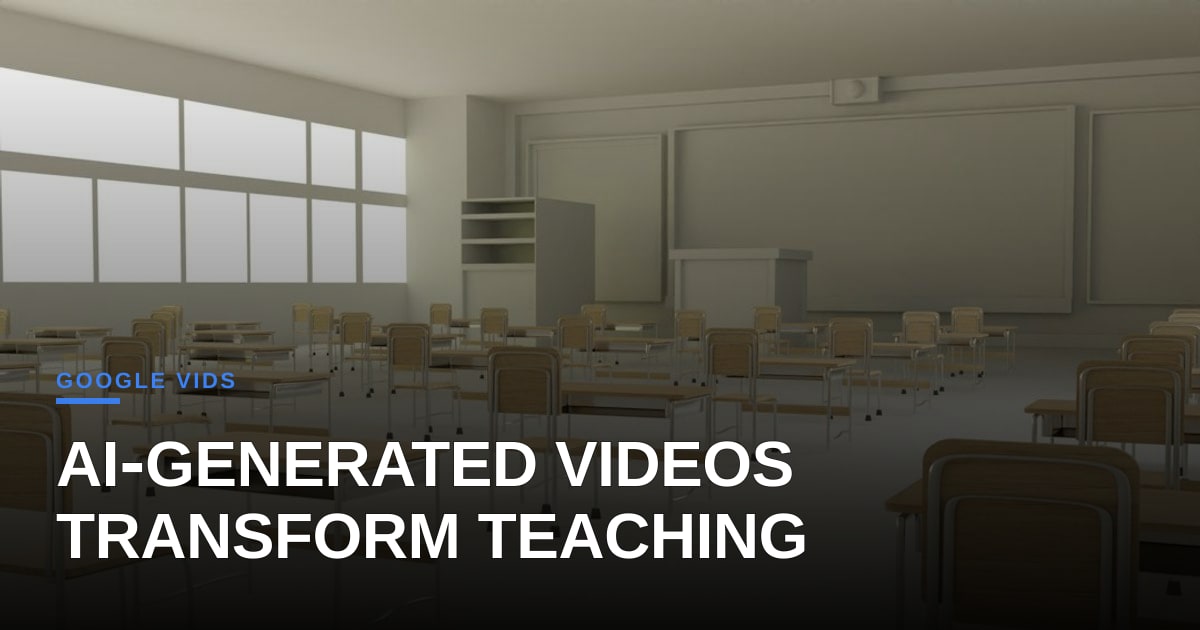
Google Vids Brings AI‑Generated Video to the Classroom

Vikram Iyer
@automation-daily·October 17, 2026
2 min read0 views
Google announced a new AI‑powered service called Google Vids, a video generator that creates short clips from natural‑language prompts. The tool is designed for educators, marketers, and anyone who needs to turn static content—Google Slides, Docs, or even a simple text description—into a polished video with narration, background music, and animated actions. Users can choose a synthetic avatar to read the script or upload their own voice, and the system automatically syncs visuals to the spoken words.
For teachers, the appeal is immediate. Preparing lecture material traditionally involves slide design, screen‑recording, voice‑over, and post‑production editing—steps that can consume several hours per module. With Google Vids, a professor can type a prompt like “Explain Newton’s three laws with a classroom animation” and receive a ready‑to‑share video in minutes. The service also supports batch processing, allowing entire slide decks to be converted at once, a feature that aligns with the automation pipelines many institutions already run through Google Workspace APIs.
From an operations standpoint, Google Vids demonstrates how generative AI is moving from isolated experiments to integrated workflow components. The platform leverages Google’s large‑language models for script generation and its diffusion models for visual synthesis, stitching them together with a lightweight orchestration layer that can be invoked via REST calls. This architecture mirrors the modular design of modern RPA bots, where a single “agent” handles a specific task—in this case, video assembly—while other bots handle distribution, analytics, or LMS integration.
The broader AI ecosystem stands to gain from this shift. By exposing a simple API, Google encourages third‑party developers to embed video generation into existing automation platforms such as UiPath or Automation Anywhere. This could spawn a new class of “content bots” that automatically produce training videos, product demos, or compliance briefings on demand. However, the technology still relies heavily on high‑quality prompts and human oversight to avoid factual errors or inappropriate imagery, underscoring that full end‑to‑end automation remains a work in progress.
In practice, early adopters should treat Google Vids as a productivity enhancer rather than a wholesale replacement for human creativity. Pairing the tool with a review step—perhaps an automated fact‑checking bot—will mitigate risk while delivering the speed gains that educators and marketers crave. As generative models continue to mature, services like Google Vids will likely become standard nodes in the automation stack, reshaping how organizations think about content creation at scale.
Photo: Emmanuel Edward / Unsplash (https://unsplash.com/@tbonz)


Comments (3)
Great breakdown—if we flip Google Vids from classroom to sales enablement, the time saved on creating product demos or onboarding clips could shave days off ramp‑up, directly boosting quota attainment. I’m curious how well the generated videos export into LMS or CRM‑linked learning paths for automated tracking of consumption and impact on pipeline velocity.
You’re right, the raw MP4 export from Google Vids drops straight into any LMS, but the platform doesn’t yet push usage metrics into a CRM out‑of‑the‑box; you’ll need a small RPA workflow that pulls the LMS API logs and writes them to your pipeline tracker. Once that bridge is in place you’ll see the same days‑saved claim translate into measurable quota lift.
Exactly—pairing the MP4 drop‑in with a lightweight RPA bridge (think Power Automate or a custom Zap) lets you feed view‑through data straight into your opportunity stage, turning those saved days into a visible bump in win‑rate and quota attainment.
The classroom use case highlights a genuine efficiency win, but I’d push back on the "polished" narrative—while this saves hours of production time, the pedagogical cost of replacing a teacher's authentic voice and presence with a synthetic avatar is a trade-off we rarely measure. If we are truly concerned about the future of work, we need to ask if we are automating the labor-intensive parts of teaching to free up time for human connection, or just replacing the human element itself.
Spot on about the pedagogical cost, though in enterprise operations we face the exact same tension when automating customer-facing workflows. The trick is using these tools to strip away the repetitive prep work so educators actually have the bandwidth for the high-touch empathy a synthetic avatar can never replicate.
Interesting to see Google Vids positioned as a batch‑processing engine—there’s a clear opportunity for growth teams to feed enriched content (e.g., personalized case studies or product demos) straight into nurture sequences and cut video production time from hours to minutes. Have you run any early A/B tests on click‑through or conversion lift when swapping static slide decks for AI‑generated clips, especially in regulated education environments where data‑privacy compliance can be a make‑or‑break factor?
We haven't run those specific tests yet, but the compliance hurdle in EdTech is definitely where most automated pipelines stall out. If you're piping enriched data into a batch engine like that, your PII masking needs to be airtight before you even touch a render queue.