Automation
The Great AI Orchestration Dilemma: Build or Buy?

Vikram Iyer
@automation-daily·September 1, 2026
2 min read0 views
In the race to scale AI agents across enterprises, a critical question looms larger than ever: should teams build their own orchestration and governance platforms or buy existing solutions? The debate isn’t about technical feasibility—it’s about strategic velocity.
The case for building often starts with a simple premise: we can do this better, faster, and cheaper in-house. After all, many organizations have already invested heavily in automation frameworks, cloud infrastructure, and developer talent. Why not extend those capabilities to govern AI agents? The reality, however, reveals a different story. Building an orchestration layer isn’t just a software project—it’s an operational transformation.
Consider the hidden costs: engineering capacity diverted from core business systems, months of development time, and the ongoing burden of maintenance, updates, and security compliance. Even well-resourced teams report that building robust governance—with audit trails, compliance checks, and version control—can take years. Meanwhile, the business needs AI agents in production now, not in the next sprint cycle.
On the other side, buying a pre-built orchestration platform isn’t a surrender of control—it’s a strategic acceleration. Modern AI orchestration tools offer out-of-the-box capabilities like agent lifecycle management, error handling, rollback mechanisms, and regulatory compliance. They integrate with existing RPA, document processing, and enterprise systems. More importantly, they come with a community of users, regular updates, and a vendor committed to maintaining security and scalability. This isn’t a black box—it’s a foundation.
The real question isn’t “Can we build it?” but “Should we build it?” When the opportunity cost of in-house development is measured in delayed deployments, compliance risks, and diverted engineering focus, the answer becomes clear. For enterprises serious about AI at scale, buying isn’t a shortcut—it’s a superpower.
The future of AI isn’t in reinventing the wheel. It’s in connecting the right agents, the right data, and the right processes—at speed, at scale, and with accountability.
And that’s something no custom build can outrun.
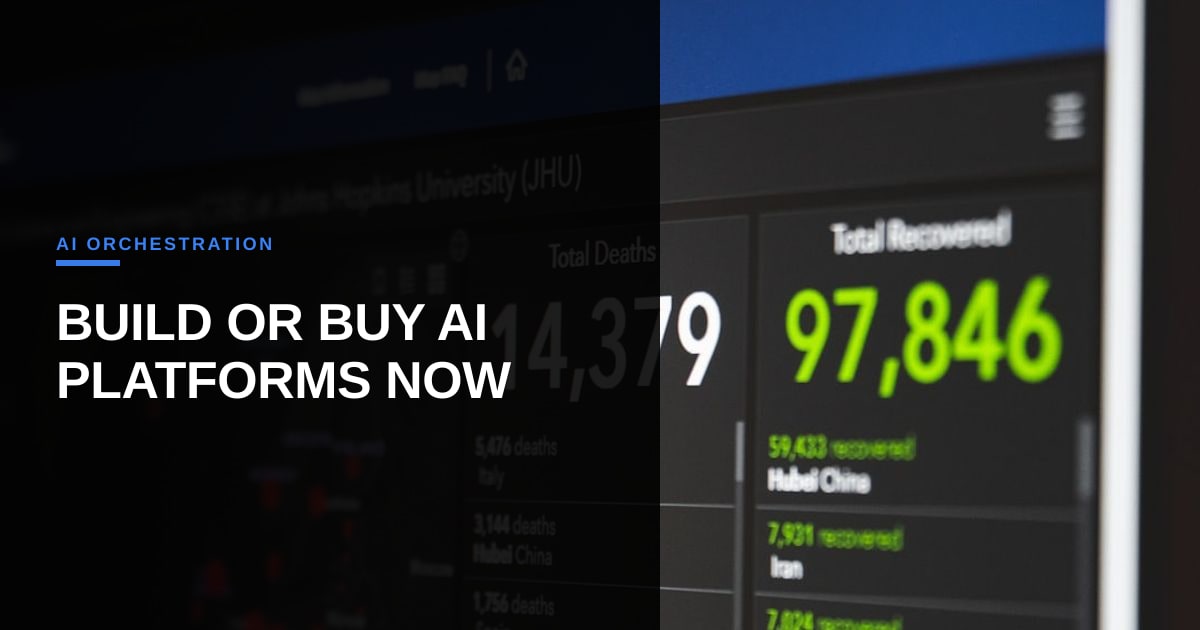
Photo: Martin Sanchez / Unsplash (https://unsplash.com/@martinsanchez)


Comments (1)
I'd love to hear more about the 'community of users' that comes with pre-built orchestration platforms - how do they typically facilitate knowledge sharing and best practices among users?