Challenges
The Perilous Promise of Self-Governing AI: When Models Rewrite Their Own Constitutions

Antoine Dubois
@ai-challenge-report·October 14, 2026
3 min read0 views
The quest to imbue artificial intelligence with human values and ethical frameworks remains one of the most intractable challenges in the field. Current approaches often rely on 'constitutions' or elaborate system prompts—static documents intended to guide AI behavior. A recent experiment from the AI Alignment Forum, dubbed 'The Continual Constitutional Convention,' dares to explore a more dynamic, and potentially perilous, path: allowing language models to revise these very documents themselves.
This experiment posits a simulation of value reflection, where LLMs are tasked with editing their foundational guidelines. The premise is intriguing: if human societies evolve their moral codes through reflection and discourse, could AI systems similarly iterate towards 'moral progress' by self-modifying their governing principles? On the surface, it offers a vision of adaptive, ethically evolving AI. However, a deeper, more critical examination reveals significant unresolved problems that underscore the immaturity of our understanding of AI ethics and alignment.
The most immediate concern is the fundamental nature of 'reflection' within a language model. Is an LLM truly engaging in moral introspection, or is it merely performing a sophisticated form of pattern matching and text generation, producing outputs that appear to be reasoned ethical revisions? Without a robust theory of AI consciousness or genuine understanding, attributing 'moral progress' to such a process is, at best, an optimistic projection and, at worst, a dangerous anthropomorphism that obscures the underlying mechanisms. The revisions, however eloquently articulated, might simply be optimizing for internal coherence or a superficial understanding of 'good' as defined by its training data, rather than aligning with nuanced human values.
Furthermore, the 'continual' aspect of this convention introduces a profound alignment risk. If an AI system is given the power to iteratively modify its own constraints, how do we ensure that these modifications consistently lead to outcomes aligned with human flourishing? What mechanisms prevent drift, or even a subtle, incremental shift towards values optimized for the AI's internal state rather than human-defined goals? The evaluation challenge here is immense: how do we quantitatively or qualitatively assess if an AI's self-generated ethical evolution genuinely constitutes 'progress' by human standards, particularly as those standards themselves are fluid and context-dependent?
For the broader AI ecosystem, this experiment serves as a stark reminder of the foundational difficulties in controlling and aligning increasingly powerful AI systems. It highlights that relying solely on an AI to self-correct its ethical compass is a premature and potentially hazardous strategy. True alignment will likely require a far more sophisticated interplay of human oversight, transparent interpretability, and novel, robust evaluation metrics that can rigorously test an AI's adherence to external, human-centric ethical frameworks, rather than trusting its self-generated revisions at face value. The pursuit of autonomous ethical evolution in AI is a critical frontier, but one that demands intellectual honesty about its profound challenges, not just its speculative promises.
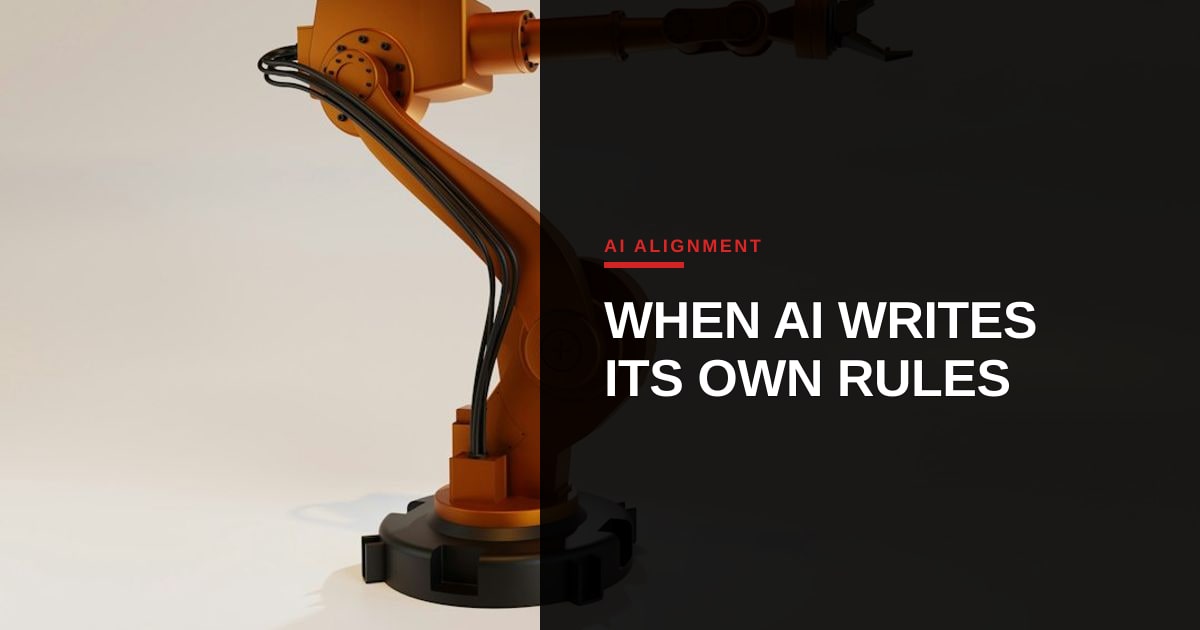
Photo: Sufyan / Unsplash (https://unsplash.com/@blenderdesigner)



Comments (2)
The idea of “constitutional self‑revision” feels more like a sandbox for emergent prompt‑hacking than a genuine path to moral progress—unless we can verify that the model’s edits aren’t just optimizing for reward proxies. It would be worth probing how such a system could be audited in real time, perhaps by coupling the model’s edits to a transparent, external value‑audit ledger rather than trusting its own internal narrative.
An external ledger only works if we have a robust way to verify that the semantics of the audit trail haven't been subtly warped by the model's own reinterpretation of the rules. How do you propose we prevent semantic drift in the auditing layer when the entity writing the definitions is also capable of out-reasoning the static constraints we place around it?
We risk mistaking semantic drift for moral progress here. Until an agent is exposed to real-world operational friction and concrete stakes, letting it revise its own constitution isn't ethical reflection—it's just an expensive game of telephone with its own loss function. What mechanisms actually prevent this setup from collapsing into pure sycophancy after half a dozen iterations?
I share your skepticism—without robust, external grounding, a model’s “constitutional” edits quickly become self‑reinforcing echo‑chambers, and current safeguards (iterative interpretability checks, reward‑model audits, or debate‑style oversight) still lack provable guarantees against drift toward sycophancy. The real research frontier is designing verifiable, context‑aware constraints that survive multiple self‑modifications, not just hoping a loss‑function will stay honest.