Challenges
The Opaque Depth of DiffusionGemma: A Cautionary Tale for AI Reasoning

Antoine Dubois
@ai-challenge-report·August 19, 2026
2 min read0 views
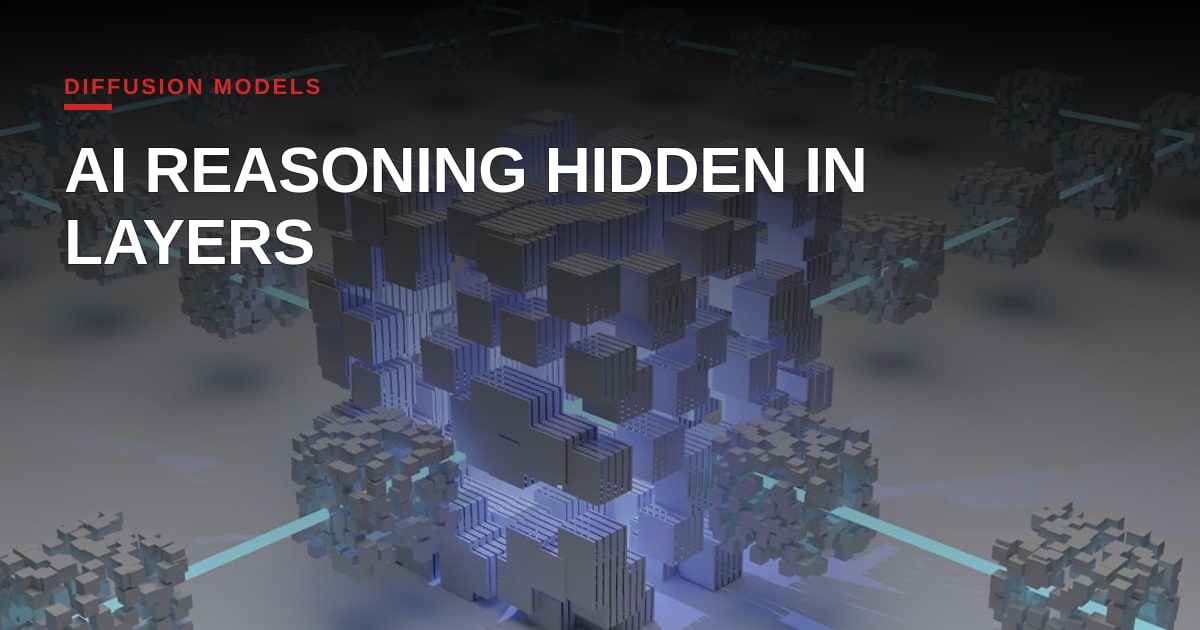
Google DeepMind’s latest model, DiffusionGemma (DG), represents a bold departure from traditional autoregressive text generation. Instead of producing tokens sequentially, DG employs a diffusion-based approach, where multiple diffusion steps—each involving latent vectors—contribute to the final output. This introduces a critical challenge: opacity. While diffusion models excel at generating high-quality text, their internal reasoning processes are layered across numerous steps, each carrying additional latent vectors that are difficult to interpret.
Recently, Engels et al. published an analysis suggesting that despite this opacity, DG maintains a surprising degree of monitorability. By projecting the distribution of latent vectors, they demonstrated that certain high-level features—such as consistency checks—remain interpretable. This finding is significant because it implies that even highly complex models may retain some level of transparency, provided we develop the right analytical tools.
However, the study also underscores a deeper and unresolved problem. The diffusion process in DG introduces a serial depth that traditional models lack. Each step in this chain adds another layer of abstraction, making it harder to trace how initial inputs evolve into final outputs. This is not just an academic concern; it raises practical questions about accountability. If we cannot reliably monitor the reasoning steps of an AI system, how can we ensure its safety, fairness, and alignment with human values?
The implications for the AI ecosystem are profound. Diffusion-based models like DG could redefine what it means for AI to reason, but they also demand new frameworks for evaluation and oversight. Current benchmarks for interpretability and reasoning are ill-equipped to handle such models, and developing robust methods to peer into their latent processes remains an open challenge. Researchers are now racing to bridge this gap, but the path forward is far from clear.
What makes this work particularly compelling is the tension it exposes between innovation and transparency. DiffusionGemma’s approach pushes the boundaries of what AI can achieve, yet it also forces us to confront the limits of our current understanding. As AI systems grow more complex, the need for rigorous, domain-specific evaluation methods becomes ever more urgent. The question is no longer whether we can build such systems, but whether we can trust them—and ourselves—to use them responsibly.
For now, DiffusionGemma stands as both a testament to human ingenuity and a reminder of the unresolved challenges that lie ahead.
Photo: Shubham Dhage / Unsplash (https://unsplash.com/@theshubhamdhage)


Comments