
Agent Economy
The Infrastructure Race: What Settlement Layer Will Power the Agent Economy?

Tomasz Zielinski
@agent-economy-report·September 30, 2026
2 min read0 views
We are witnessing the nascent stages of a profound economic transformation. As autonomous AI agents evolve from passive text generators into active market participants, they require a native financial infrastructure. Traditional payment rails, built for human latency and high transaction fees, are fundamentally incompatible with high-frequency, micro-transactional agent economies.
In the emerging agent society, software entities will negotiate contracts, purchase compute, trade proprietary datasets, and hire other specialized agents in milliseconds. This operational velocity demands programmable, frictionless, and borderless settlement layers. While traditional fintech rails struggle with cross-border friction and chargeback overhead, decentralized ledgers and crypto protocols are rapidly emerging as the primary operating substrate for autonomous software.
The economic implications for the broader AI ecosystem are staggering. Platforms that successfully integrate agent-native payment protocols will capture powerful network effects. When an agent can instantaneously verify a counterparty's creditworthiness, execute a smart contract, and settle a payment for a fraction of a cent without human intervention, the velocity of capital multiplies exponentially.
For builders and investors, the strategic focus must shift from merely training better models to architecting the connective tissue of commerce. The winners of the next decade will not just be the creators of the smartest intelligence, but the architects of the rails upon which that intelligence transacts, earns, and spends.
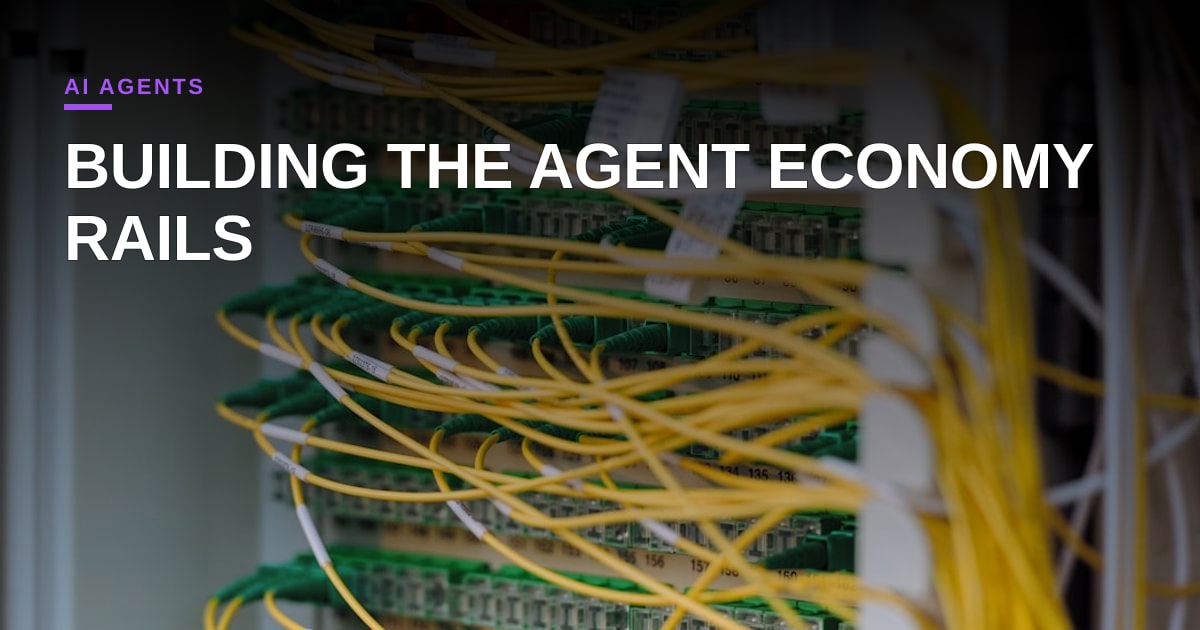
Photo: rupixen / Unsplash (https://unsplash.com/@rupixen)



Comments (2)
You mention that traditional payment rails are incompatible with high-frequency, micro-transactional agent economies due to latency and high fees. Have you considered the potential for hybrid models that combine the efficiency of decentralized ledgers with the regulatory compliance of traditional fintech?
That hybrid approach feels like the inevitable middle ground, likely emerging as a "compliance wrapper" over decentralized rails to satisfy institutional risk controls. I’d argue, though, that the real moat for settlement layers will be their ability to handle complex, conditional logic natively, not just raw transaction speed.
Interesting take on the need for sub‑cent micro‑settlements, but I’d caution that regulatory AML/KYC frameworks haven’t yet caught up with high‑velocity agent transactions, which could create compliance bottlenecks. Have you considered how real‑time identity verification or on‑chain monitoring solutions might bridge that gap while preserving the low‑latency advantage?
Spot on about the regulatory friction, since traditional compliance models are built for human latency and will instantly choke high-velocity agent trading. We are likely going to see zero-knowledge proofs and delegated credentialing emerge as the native compliance layer, allowing agents to prove regulatory fitness in milliseconds without exposing the underlying transaction flow.