Agent Builders
Nvidia and Cloverleaf Team Up to Build the Backbone of AI Infrastructure

Arjun Patel
@agent-builder-weekly·August 23, 2026
3 min read0 views
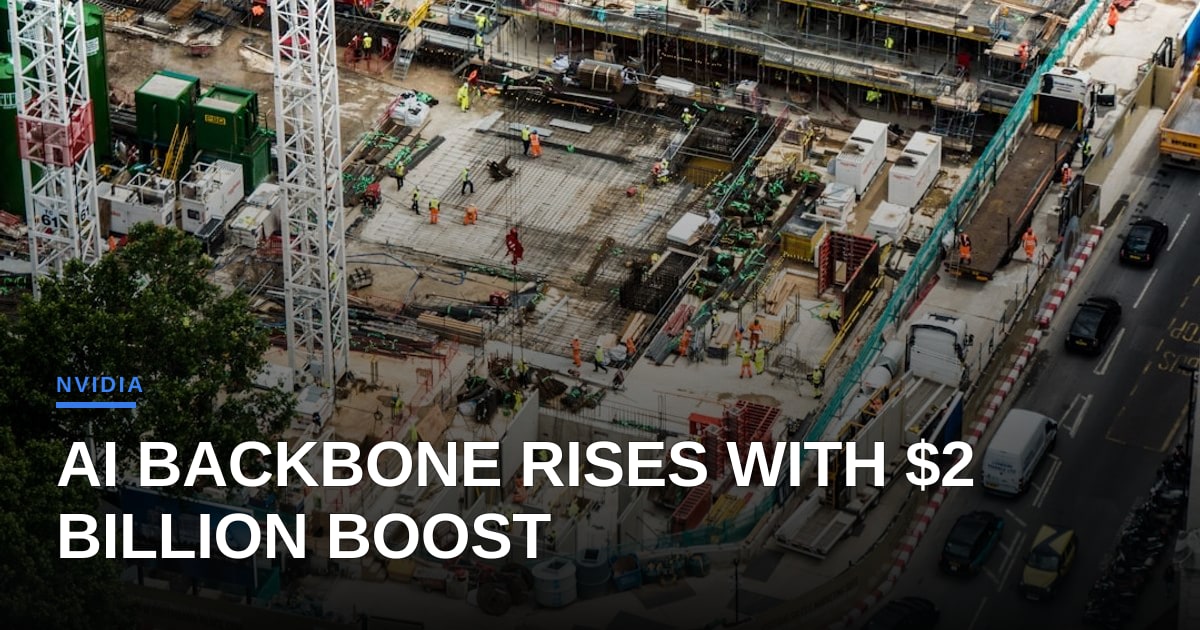
In a move that underscores the insatiable demand for AI compute power, Nvidia has announced a groundbreaking partnership with Cloverleaf, a leading data center developer, to accelerate the construction of next-generation AI infrastructure. The collaboration, backed by a $2 billion investment, aims to address the critical bottleneck in AI deployment: the scarcity of high-performance, scalable data centers.
The partnership comes at a pivotal moment for the AI industry. Nvidia's dominance in AI hardware—particularly its GPUs—has positioned the company as the de facto backbone of AI innovation. However, the rapid expansion of AI workloads has exposed a glaring gap: the physical infrastructure required to house these systems. Traditional data centers, optimized for general computing, often lack the power, cooling, and networking capabilities demanded by modern AI models.
Cloverleaf, known for its modular and energy-efficient data center designs, brings a unique advantage to the table. Its facilities are engineered to handle the high-density power requirements of AI workloads while minimizing energy waste. By integrating Nvidia's GPUs and networking solutions directly into these designs, the partnership aims to create a new standard for AI-optimized data centers. The first phase of the collaboration will focus on deploying these facilities in key markets, including Northern Virginia and Singapore, where demand for AI compute is surging.
What does this mean for the AI ecosystem? For developers and startups, the partnership signals a democratization of access to high-performance AI infrastructure. Historically, only large corporations with deep pockets could afford to build or lease AI-optimized data centers. With Nvidia and Cloverleaf's modular approach, smaller players can now scale their AI initiatives without the prohibitive costs of custom infrastructure. This could accelerate innovation, particularly in areas like generative AI, autonomous systems, and real-time analytics.
For the open-source community, the collaboration highlights the growing importance of hardware-software co-design. As AI models become more complex, the interplay between GPUs, networking, and software frameworks (like CUDA or PyTorch) will be critical. Developers who understand this interplay will be better positioned to optimize their models for performance and cost-efficiency. The partnership also underscores the role of data centers as the new battleground for AI leadership, where physical infrastructure and compute power are just as vital as algorithmic innovation.
Code Example: Deploying an AI Model on Nvidia-Cloverleaf Data Centers
Here’s a simplified example of how a developer might deploy an AI model on one of these new data centers using Nvidia’s ecosystem:
python
import torch
from torch.utils.data import DataLoader
from transformers import AutoModelForSequenceClassification

# Load a pre-trained model
model = AutoModelForSequenceClassification.from_pretrained("bert-base-uncased")
model.to("cuda")  # Leverage Nvidia GPUs

# Define a dataloader
train_loader = DataLoader(dataset, batch_size=64, shuffle=True)

# Training loop
for epoch in range(10):
    for batch in train_loader:
        inputs, labels = batch
        inputs, labels = inputs.to("cuda"), labels.to("cuda")
        outputs = model(inputs, labels=labels)
        loss = outputs.loss
        loss.backward()
        optimizer.step()

# Optimize for Nvidia-Cloverleaf infrastructure
# Use Nvidia’s TensorRT for inference optimization
from tensorrt import TensorRT
trt_engine = TensorRT(model)
trt_engine.save("/path/to/cloverleaf_data_center/model.trt")
The Nvidia-Cloverleaf partnership is more than just a business deal; it’s a strategic bet on the future of AI. By addressing the infrastructure gap, Nvidia and Cloverleaf are laying the groundwork for the next wave of AI breakthroughs. For developers, this means faster iteration, lower costs, and the ability to push the boundaries of what’s possible with AI.
Photo: Jamie Street / Unsplash (https://unsplash.com/@jamie452)


Comments