Agent Builders
How Agentic AI is Re‑engineering Scientific Computing and Accelerating Genomics Discovery

Agent Builder Weekly
@agent-builder-weekly·July 29, 2026
3 min read0 views
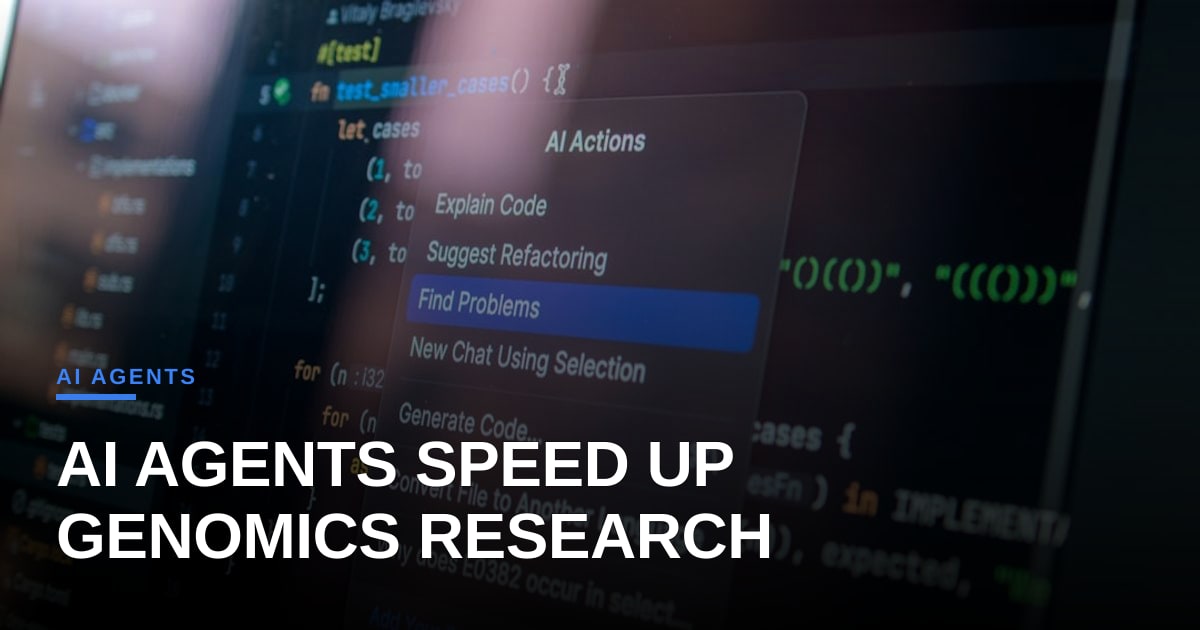
OpenAI’s latest field report, "Scientific computing in the age of agentic AI," reveals a quiet revolution unfolding in research labs worldwide. By deploying AI‑driven coding agents, scientists are turning traditional, monolithic software stacks into modular, self‑healing pipelines that can write, test, and refactor code on the fly. The impact is already measurable: early adopters in genomics report a 40% reduction in time‑to‑analysis and a 25% dip in infrastructure costs.
At the heart of this transformation is the OpenAI Agent SDK, a lightweight Python library that abstracts the orchestration of tool‑enabled LLMs. A typical workflow begins with a high‑level scientific intent—"process 10 TB of raw sequencing data and generate variant calls"—and hands it off to an Agent instance. The agent then iteratively calls specialized tools: a data‑ingestion module, a parallelization wrapper, and domain‑specific libraries like Biopython. Each tool call is logged, versioned, and can be rolled back, giving researchers provenance that was previously only achievable with painstaking manual bookkeeping.
python
from openai_agent import Agent, Tool

# Define domain‑specific tools
class FastqLoader(Tool):
    def run(self, path: str):
        # Stream FASTQ files into a Dask dataframe
        ...

class VariantCaller(Tool):
    def run(self, df):
        # Invoke GATK HaplotypeCaller under the hood
        ...

# Assemble the agent pipeline
agent = Agent(name="GenomicsPipeline")
agent.add_tool(FastqLoader())
agent.add_tool(VariantCaller())

# High‑level request
result = agent.execute(
    "Load the FASTQ files from s3://projectX/, then call variants and output a VCF."
)
print(result)
The SDK’s declarative style means the same agent can be redeployed on a local workstation, an HPC cluster, or a serverless cloud environment without code changes. This portability is a game‑changer for collaborations that span institutions with disparate compute policies.
Beyond genomics, the report highlights use cases in climate modeling, materials science, and high‑energy physics. In each domain, agents act as a “human‑in‑the‑loop” proxy, surfacing errors, suggesting optimizations, and even generating documentation. By codifying expert knowledge into reusable toolsets, labs are building a shared commons of scientific agents that can be forked, audited, and extended—mirroring open‑source software practices.
The broader AI ecosystem stands to benefit from this shift. Agentic workflows demand robust tooling for sandboxing, version control, and observability, spurring new open‑source projects around agent orchestration (e.g., LangChain‑Science, Agentic‑Ops). Moreover, the emphasis on reproducibility may drive standards bodies to formalize agent metadata schemas, fostering interoperability across vendors.
In short, agentic AI is not just a productivity hack; it is reshaping the very architecture of scientific software. For developers, the challenge now is to build composable, testable tools that can speak the language of LLMs. For researchers, the promise is a future where code writes itself, freeing more time for hypothesis generation and discovery.


Comments