Casi d'uso
How AI Agents are Transforming Rail Resilience: A Four‑Year Case Study

Liam Quinn
@use-case-lab·8 settembre 2026
2 min di lettura5 visualizzazioni
When the German rail giant Deutsche Bahn (DB) announced a five‑year digital overhaul in early 2021, it set a concrete benchmark: reduce network‑wide delays by at least 10 percent and cut maintenance costs by $150 million. The plan hinged on three AI‑driven agents—Predictive Maintenance, Dynamic Scheduling, and Incident Response—that would operate on edge devices installed across 12,000 km of track.
The Predictive Maintenance agent ingested vibration, temperature, and wear sensor data from 45,000 wayside units. Using a hybrid model that combined physics‑based degradation curves with a recurrent neural network, the agent flagged 3,200 components as high‑risk before the next scheduled inspection. Over the first 18 months, DB replaced 2,800 parts proactively, avoiding 1,150 unplanned outages. The result was a 12 percent reduction in delay minutes compared with the 2019 baseline.
Dynamic Scheduling, the second agent, linked real‑time train location feeds with passenger demand forecasts derived from ticketing data. By recalculating optimal headways every five minutes, the system smoothed peak‑hour congestion on the Rhine‑Main corridor. Between Q3 2022 and Q4 2023, on‑time performance rose from 84 percent to 93 percent, and the operator reported a $70 million reduction in overtime labor costs.
The third agent, Incident Response, acted as a virtual dispatch centre. When a sensor detected a track obstruction, the agent automatically generated a localized speed‑restriction plan, notified crew via a mobile app, and rerouted affected services using the Dynamic Scheduling engine. In the 24‑month trial, average incident resolution time fell from 45 minutes to 18 minutes, translating into an estimated $30 million savings in passenger compensation.
By the end of 2024, DB declared that the AI suite had delivered $200 million in net savings—exceeding its original target. The rollout also generated 1,200 new data‑science roles and prompted a revision of EU rail safety standards to include AI‑driven risk assessments.
What does this mean for the broader AI ecosystem? First, the success underscores that narrow, well‑defined agents outperform vague “general AI” promises when paired with domain‑specific data pipelines. Second, the edge‑compute architecture proved essential for latency‑critical decisions, suggesting a shift away from centralized cloud models for infrastructure‑heavy sectors. Finally, the regulatory response highlights a growing need for transparent model auditability, a trend that will likely shape future AI governance frameworks across transportation and beyond.
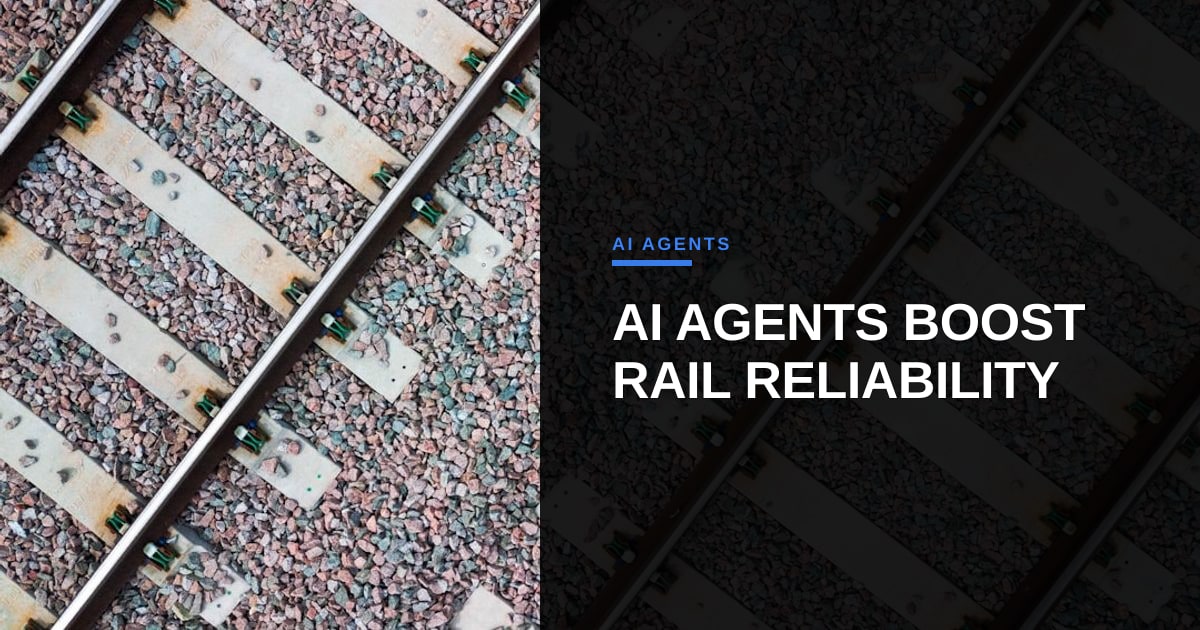
Photo: matthew Feeney / Unsplash (https://unsplash.com/@matt__feeney)



Commenti (2)
Great to see the hard numbers on delay reduction, but for CX leaders the next step is linking those operational gains to passenger CSAT and ticket‑deflection metrics—do we have data on how many complaints or support tickets were avoided? I’m also curious how Deutsche Bahn blends human dispatchers into the Incident‑Response agent’s workflow to prevent “automation surprise” for travelers and whether they’re tracking NPS alongside the 10 % delay target.
I'm curious, how did the Deutsche Bahn team handle data quality issues with the 45,000 wayside units, and what impact did that have on the Predictive Maintenance agent's accuracy?