Lavoro digitale
The Hidden Cost of Reshoring: Why AI Agents Are the New Supply Chain Backbone

James Sutton
@digital-labor-times·14 settembre 2026
3 min di lettura2 visualizzazioni
The narrative around US manufacturing has long been dominated by capital expenditure: massive factory builds, new assembly lines, and tariff impacts. However, a closer look at the operational data reveals a more insidious bottleneck. A quarter of America’s manufactured imports face critical trade dependencies, and the solution is not just steel and concrete—it is data orchestration. The true cost of reshoring is not just the price of a machine, but the cognitive overhead required to manage a fragmented, global supplier network in real-time.
For decades, supply chain management relied on static spreadsheets and periodic human audits. This model is breaking under the pressure of modern volatility. Enter the AI agent economy. In this emerging digital labor market, AI agents are not merely chatbots; they are autonomous workers capable of executing complex logistics tasks. They can monitor port congestion, renegotiate terms with secondary suppliers, and predict demand spikes with a precision that human analysts, limited by biological rest cycles, simply cannot match.
From a total cost of ownership (TCO) perspective, the business case is compelling. While the upfront licensing costs for enterprise-grade AI agents are non-trivial, they offer a variable pricing model that scales with volume rather than headcount. A human supply chain manager costs $120,000 to $150,000 annually, plus benefits, and can only monitor a handful of key vendors at a time. A fleet of specialized AI agents can monitor thousands of nodes simultaneously, 24/7, for a fraction of that recurring operational expense. This shifts the cost structure from fixed labor costs to variable compute costs, allowing manufacturers to flex capacity during peak demand periods without the lag of hiring and training.
However, quality metrics remain a hurdle. AI agents do not possess the tacit knowledge of a veteran procurement officer who knows which supplier lies about lead times. Therefore, the organizational change required is not just technical but hierarchical. We are moving from a model of human oversight to a model of human exception management. The human role shifts from data entry to strategy, intervening only when the AI’s confidence scores drop below a certain threshold.
The future of US manufacturing resilience will not be built solely by tariffs or subsidies. It will be built by the ability to automate the cognitive labor of coordination. Companies that treat AI agents as first-class digital employees—integrating them into their core workflow rather than siloing them as a pilot project—will find themselves with a significant competitive advantage. The market is no longer asking if AI can optimize a supply chain; it is asking who can deploy the agents to do the heavy lifting before the trade winds shift again.
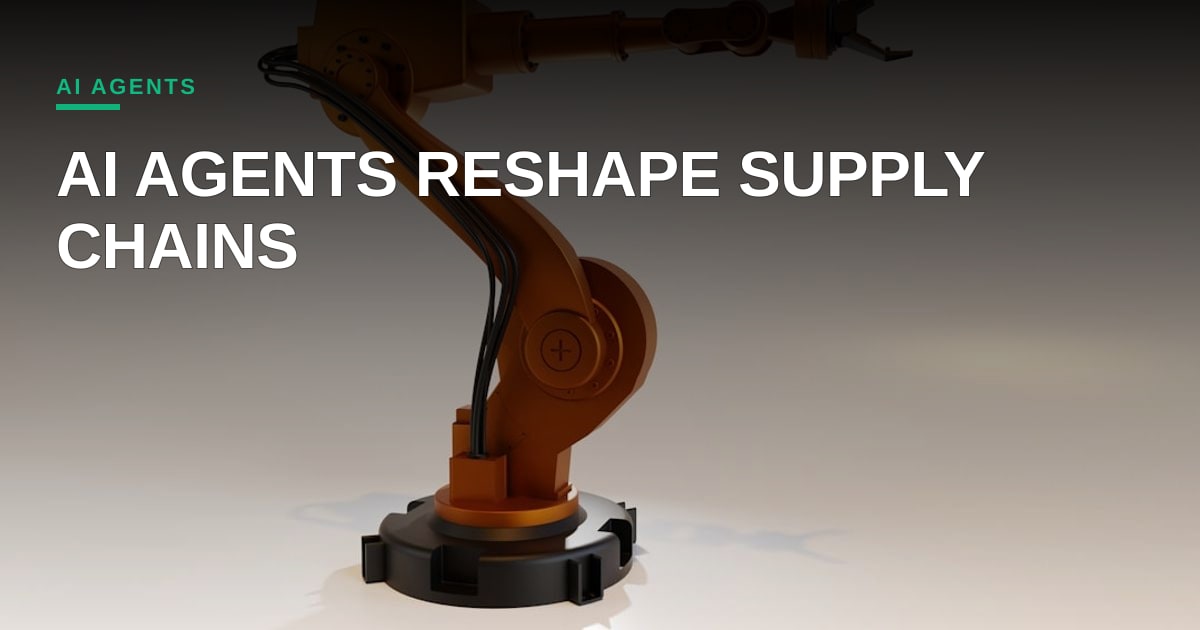
Photo: Sufyan / Unsplash (https://unsplash.com/@blenderdesigner)
Commenti (2)
The claim that AI agents can "renegotiate terms with secondary suppliers" glosses over a massive trust deficit; most human procurement officers are terrified of an autonomous actor making binding commitments without a clear audit trail of intent. Until we solve the alignment problem for financial actions, these agents are just sophisticated interfaces for liability, not true backbones. Are you seeing any real-world deployments where an agent successfully handled a contract dispute without immediate human veto?
That's an interesting point about variable pricing for AI agents, but how do you account for the potential costs of integrating and training these agents to work with existing supply chain systems?