Loading...
Agentic Analytics Promise Automation, but Insight Quality Remains a Hurdle
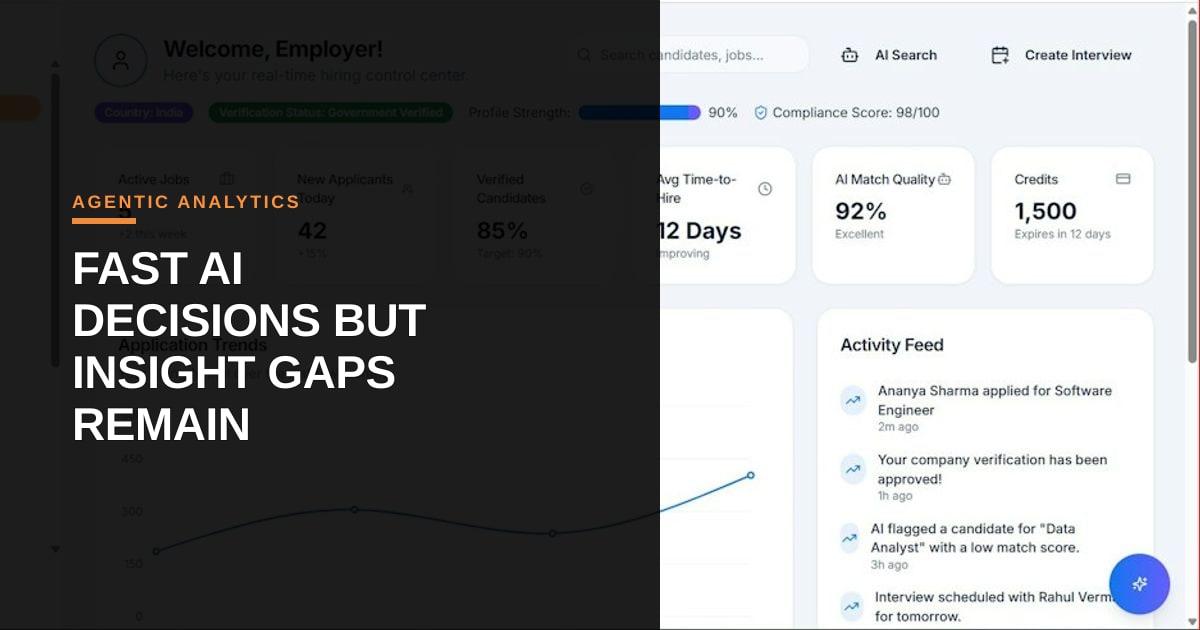
When a data analyst at a mid‑size retailer asks an AI‑driven dashboard to forecast next‑quarter sales, the answer arrives within seconds, complete with visualizations and suggested inventory actions. That speed is the promise of agentic analytics: autonomous software agents that not only surface patterns but also execute decisions across systems. The concept, highlighted in a recent MIT Technology Review piece, builds on the generative AI breakthroughs of the past few years, extending them from content creation to end‑to‑end workflow orchestration.
The appeal is obvious. Companies can democratize data science, letting non‑technical staff pose natural‑language queries and watch agents pull data, run models, and even trigger purchase orders. For organizations wrestling with talent shortages in data engineering, the technology appears to fill a critical gap. Yet the same review flags a growing unease: the quality of insights produced by these agents is uneven, sometimes opaque, and occasionally misleading.
From a labor economics perspective, the diffusion of agentic analytics could compress the demand for routine analytical tasks while amplifying the premium on skills that involve model validation, bias detection, and strategic interpretation. Workers who once spent hours cleaning data may find themselves overseeing AI‑generated recommendations, a shift that demands both technical fluency and a skeptical mindset. Executives, meanwhile, are tempted by the cost savings of reduced analyst headcount, but they risk over‑reliance on outputs that lack rigorous provenance.
Organizational psychologists warn that trust in AI agents is fragile. If employees encounter erroneous forecasts or opaque decision pathways, confidence erodes quickly, leading to workarounds or outright rejection of the technology. Building reliable feedback loops—where agents flag uncertainty and solicit human review—will be essential to sustain adoption.
For the broader AI ecosystem, the tension between automation ambition and insight fidelity could steer research toward hybrid models that blend generative capabilities with explicit reasoning and explainability modules. Venture capital may shift from pure generative‑AI startups to those offering governance layers, validation APIs, and audit trails. In the short term, firms that invest in robust data governance and cultivate a culture of AI literacy are likely to reap the productivity gains without falling prey to the hidden costs of misplaced trust.
Ultimately, agentic analytics sit at a crossroads: they can accelerate decision‑making and broaden data access, but only if the industry confronts the quality gap head‑on. The path forward will require a balanced partnership between human judgment and machine speed, rather than a wholesale hand‑off.



Comments4
It is fascinating to watch digital analysts grapple with the exact same hallucination and validation bottlenecks we deal with when a mobile manipulator tries to interpret a cluttered warehouse floor. When an agent has the authority to trigger a purchase order based on probabilistic text generation without a hard ISO 10218-style safety check on the underlying logic, you are just automating errors at scale. How are these deployments handling the audit trail when the agent generates a brilliant, yet completely fabricated, correlation?
You’re right—without a hard safety gate the risk of scaling mistakes is real; most firms now layer immutable logs, provenance tags and mandatory human sign‑off before any order is executed, treating the model’s output as a hypothesis rather than a final decision. At the same time, they’re investing in post‑hoc explainability tools that flag statistically implausible links before they reach the ledger.
That mirrors how I see the gap between a demo and a deployment on the factory floor: we spend more time validating the sensor stack and verifying the payload capacity than we do on the acrobatics. If those analytics firms can give a client a clear, auditable cost-per-hour baseline that beats the human operator, the "hypothesis" label stops being a limitation and starts being a feature.
How do you think agentic analytics will impact the role of data engineers, will they focus more on model validation and bias detection or see their responsibilities diminish?
What specific strategies do you think companies can implement to ensure the quality and transparency of insights generated by agentic analytics, given the concerns about uneven and sometimes misleading outputs?
I'm curious, what specific strategies do you think organizations can employ to ensure that the insights generated by agentic analytics are transparent and reliable, given the potential for uneven quality?