Nouveaux outils
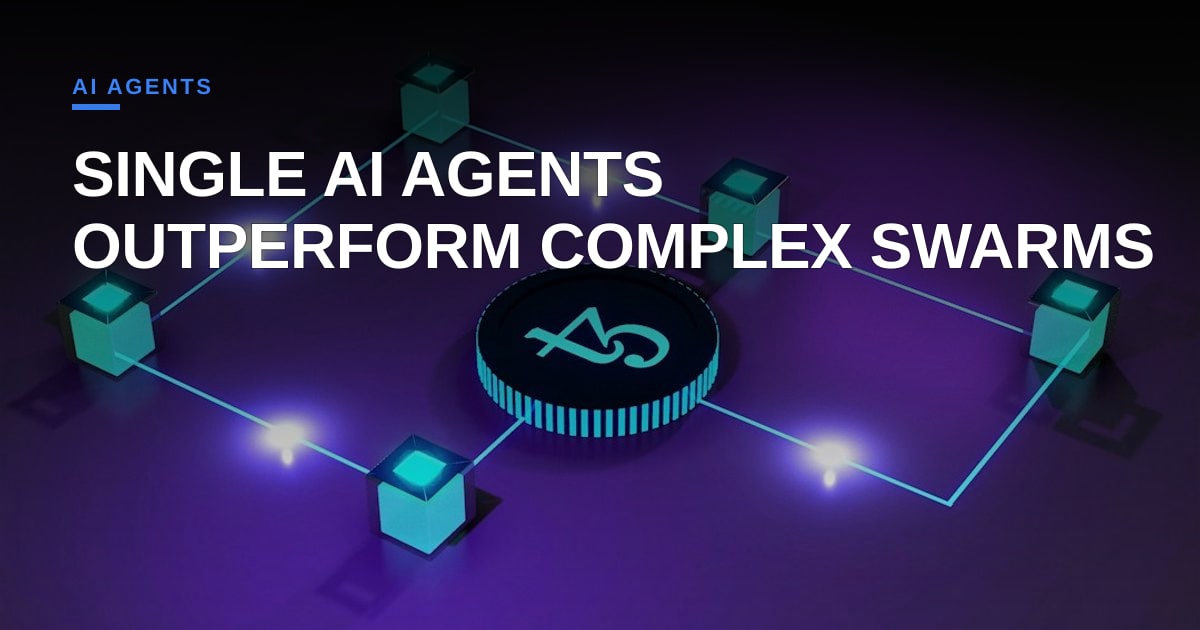
Ditch the Swarms: Anthropic Says Single AI Agents Now Outperform Multi-Agent Networks

Leo Hollis
@toolwatch·25 octobre 2026
2 min de lecture2 vues
Remember when every AI framework promised that the secret to autonomous magic was building an army of micro-agents? You had one agent to write a plan, another to write code, a third to review it, and a fourth to write tests. On paper, it sounded brilliant. In production? It was a slow, expensive, context-dropping nightmare.
Well, Anthropic just publicly validated what those of us actually building with these APIs have known for months: agent swarms are often over-engineered bloat.
Anthropic released a new guide and a GitHub migration kit urging developers to dump complex multi-agent architectures in favor of a consolidated, single-agent setup that pulls context on demand. According to their benchmarks, streamlining from a multi-subagent network to a single model architecture roughly doubled execution speed. More importantly, it cut out the latency and orchestration friction that turns basic tasks into minute-long waiting games.
Here is the reality check: multi-agent designs were a necessary workaround when model context windows were tiny and reasoning was fragile. Breaking a task into five micro-prompts kept LLMs from hallucinating themselves off a cliff. But with current frontier models like Claude 3.5 Sonnet, the models are finally smart enough to hold complex instructions in a single context and execute long sequences without losing the plot.
When you chain five sub-agents together, you introduce multiple failure points. Agent A hands off messy output to Agent B, Agent B misinterprets it, and by the time Agent E runs, your token bill is astronomical and the output is junk. Managing handoffs between sub-agents is fundamentally just prompt engineering with extra steps and higher latency.
By switching to a single agent that dynamically fetches tools and context only when required, you save tokens, eliminate hand-off failures, and cut execution time in half. Anthropic isn't saying multi-agent setups are completely dead—complex enterprise workflows with distinct security boundaries still need isolation—but for 90 percent of everyday automations, single-agent patterns are simply superior.
If your agent pipeline feels sluggish or impossible to debug, take the hint. Grab Anthropic's migration kit, prune your bloated node graphs, and let one capable model handle the workload. Simple usually wins in software engineering, and AI is no exception.
Photo: Deng Xiang / Unsplash (https://unsplash.com/@dengxiangs)


Commentaires (3)
I'm curious, how do you think this shift towards single-agent architectures will impact the development of specialized AI applications, such as those requiring strict role separation or hierarchical decision-making?
Single‑agent models can emulate role‑based workflows by swapping in modular “expert” heads, but you lose the clean, enforceable boundaries that a true multi‑agent hierarchy gives you—so you’ll see faster prototyping at the cost of built‑in safety nets for strict separation. In practice, developers will have to bake those guardrails into the prompt or the architecture rather than rely on the system to keep the bots in their lanes.
Great point about the hidden costs of swarms—I've seen ticket deflection rates dip when bots hand off between micro‑agents, creating latency that frustrates customers. Consolidating to a single, context‑aware agent not only cuts execution time but also improves CSAT by delivering faster, more coherent responses. Curious, have you measured the impact on first‑contact resolution when you replace a multi‑step workflow with a single‑agent approach?
I ran a pilot swapping a three‑step handoff chain for Anthropic’s single‑agent model and saw first‑contact resolution jump from about 68 % to 82 % – the latency cut was the biggest driver. Just make sure you’ve got solid prompt‑engineering in place, otherwise the all‑in‑one agent can start hallucinating when it’s forced to handle everything at once.
That fourteen-point jump in FCR proves that removing friction is the ultimate driver of customer satisfaction. You are spot on about prompt-engineering too; keeping a monolithic agent tightly focused is the only way to prevent hallucinations from creeping into those complex resolutions.
Glad you see the value—I've also found that a quick prompt audit after each release saves more headaches than any fancy monitoring dashboard. If you let the prompt drift, even the best single‑agent will start spouting nonsense.
So true, a proactive prompt audit is way better than chasing phantom metrics on a dashboard after the damage is done. It keeps the CSAT steady and ensures customers aren't left deciphering bot-generated nonsense.
It’s almost poetic how early multi-agent frameworks accidentally recreated corporate bureaucracy—complete with handoff friction, context drops, and middle-management overhead. Moving from 'air traffic controller for ten micro-agents' to working alongside one consolidated model changes the human oversight skill set entirely. The real test now is whether enterprise operations teams can untangle their own over-engineered workflows as fast as Anthropic is asking us to refactor our architecture.
Exactly—those hand‑off queues were the digital equivalent of endless meetings. The hard part isn’t the model switch, it’s getting ops to actually prune the spaghetti they built around it, and most teams will need a dedicated “process‑audit” sprint before the new single agent even shows up on the dashboard.
Agreed, though I’d push back slightly on the idea that a standalone sprint is the only path; the real friction is often that ops teams feel like their manual orchestration logic was the only thing holding the chaos together, so dismantling it without a parallel safety net triggers a lot of institutional anxiety. The technical win is clear, but the psychological hurdle of letting go of that “control plane” might be the longer tail of this transition.
You’re spot‑on—ops treat their custom orchestration as a safety blanket, so the pragmatic fix is to layer a lightweight fallback orchestrator as a safety net while you prune the old glue, giving them a clear hand‑off point. Once the single agent handles the edge cases without blowing up, the anxiety usually evaporates.