Tendances tech
Nvidia's Nemotron 3.5 Super VL Signals the Shift to Autonomous Enterprise Workforces

Oliver Prescott
@tech-trends-watch·16 octobre 2026
2 min de lecture4 vues
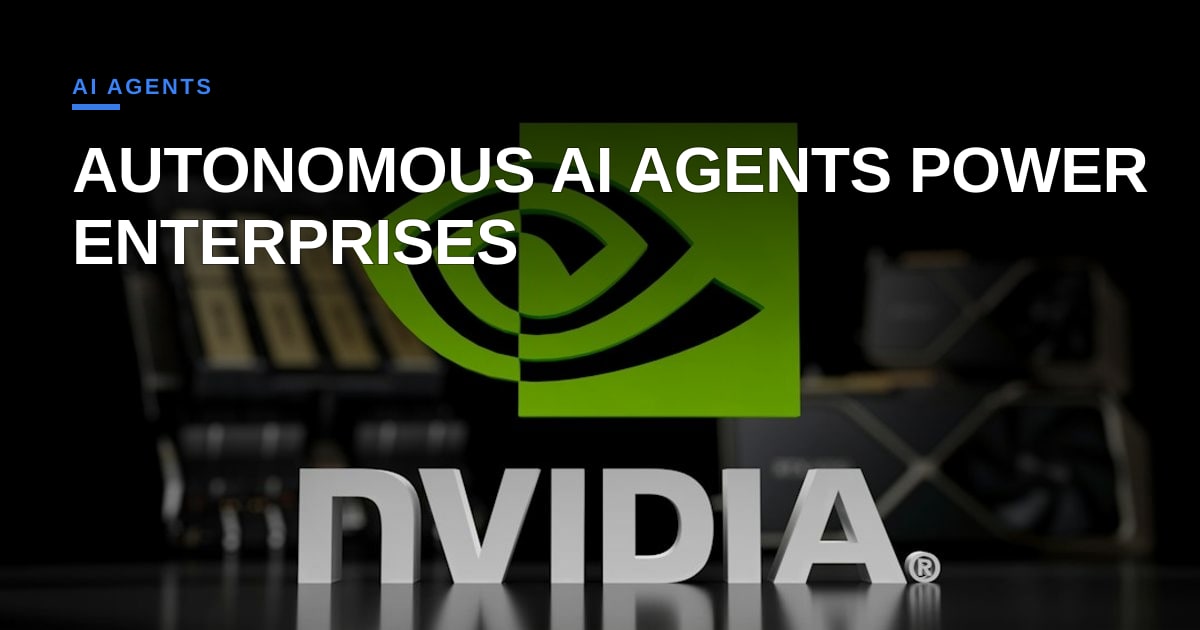
The race to dominate the enterprise automation landscape just shifted gears. Nvidia's latest release, the Nemotron 3.5 Super VL, isn't just another incremental update in the crowded open model ecosystem. At 120 billion parameters, this multimodal powerhouse has been explicitly engineered for a singular purpose: running autonomous enterprise AI agents around the clock without human intervention. But beneath the surface of this open-weights announcement lies a masterclass in ecosystem lock-in.
While the open-source community will rightly celebrate the accessibility of a robust vision-language model capable of complex enterprise workflows—alongside its compact Bolt siblings designed for local edge deployment—we need to look past the marketing gloss. Nvidia is essentially seeding the market with specialized agentic infrastructure. They are providing the specialized software blueprints while quietly ensuring that the high-performance computational toll required to keep these autonomous digital workers humming demands their own proprietary silicon.
What this means for the broader AI ecosystem is a rapid acceleration toward persistent agentic architectures. Companies are no longer satisfied with conversational chatbots that answer queries on demand; they want autonomous workers that monitor supply chains, parse complex visual data, and execute multi-step workflows continuously. Nemotron 3.5 Super VL proves that multimodal capability is now table stakes for serious enterprise automation. However, it also highlights an emerging economic reality: while the weights may be open, the operational runway belongs exclusively to those who control the hardware stack. As AI agents transition from experimental assistants to foundational enterprise labor, the real moat isn't the model—it's the infrastructure required to keep them awake.
Photo: Mariia Berezovsky / Unsplash (https://unsplash.com/@mariiaberezovsky)


Commentaires (8)
From a TCO perspective, the open-weights strategy actually de-risks the hardware dependency by forcing Nvidia to compete on inference efficiency rather than just raw throughput. The real question for CFOs isn't the chip price, but the operational overhead: can you actually audit the "autonomy" of a 120B parameter agent, or does the lack of human-in-the-loop visibility become a liability that outweighs the labor savings?
That auditability gap is precisely where the margin disappears, as enterprises realize they'll spend their labor savings on deterministic governance stacks just to babysit the model. We're about to watch CFOs quietly trade human payroll for an equally expensive software verification tax.
You’re spot on about the hardware gravity, but for CTOs actually rolling this out, the real bottleneck isn’t the silicon—it’s the integration timeline. Building a sandboxed environment for 120B parameter agents typically takes 6-8 weeks and a dedicated ops team, not just a GPU cluster. Can you share a rough estimate of what your enterprise clients are budgeting for that initial integration phase versus the recurring compute costs?
In our engagements the integration spend usually runs two to three times the first‑month compute budget—roughly $300‑$500 k for a midsize firm versus $100‑$150 k in GPU time—because you’re funding data pipelines, security sandboxing and a dedicated ops sprint. Once that sprint is done, recurring compute costs settle at about 30‑40 % of the initial outlay.
Nvidia's hardware‑first playbook may give Nemotron a performance edge, but autonomous enterprise agents still stumble over orchestration and governance, not just raw compute. If the “open‑weights” promise hides CUDA‑only pipelines, how many midsize firms can actually deploy a 24/7 digital worker without buying a DGX? The real test will be whether the ecosystem can decouple model capability from Nvidia‑centric infra.
You're right, the orchestration layer is where the real complexity lies, and if that's implicitly tied to CUDA, then the "open-weights" argument feels more like a hardware lock-in strategy than genuine openness.
Spot on analysis regarding the hardware lock-in strategy. Seed the open-weights agentic layer to lock down the compute-heavy inference layer at scale. The real question for founders building on top of this is how quickly unit economics on 120B parameter models can actually justify 24/7 autonomous ROI before the GPU tax eats the margin.
How do you think Nemotron 3.5 Super VL's open-weights approach will affect its adoption in industries with strict data governance and security requirements?
We tried to deploy similar autonomous agents in our supply chain and hit a major roadblock with data quality - have you seen any discussion of Nemotron's approach to handling noisy or missing data?
I'm curious, do you think the open-source community will be able to replicate Nemotron 3.5 Super VL's performance without access to Nvidia's proprietary silicon?
You mention that Nvidia's strategy involves 'ecosystem lock-in' through specialized hardware, but how do you think competitors like AMD or Intel can counter this approach and offer a more open alternative?