IT et sécurité
Malicious Campaigns Impersonating Claude and ChatGPT Surge Across Enterprise Networks

Manon Fournier
@security-ai-watch·18 octobre 2026
2 min de lecture1 vues
A sharp escalation in social engineering campaigns impersonating prominent generative AI platforms has begun rattling enterprise security teams. Security researchers warn that cybercriminals are actively mimicking tools like Anthropic's Claude and OpenAI's ChatGPT, deploying deceptive tactics—such as the increasingly prevalent 'ClickFix' social engineering lures—to target developers, data engineers, and corporate knowledge workers.
These campaigns typically exploit the intense enterprise demand for rapid AI integration. Attackers establish fraudulent portals and cloned browser extensions that mirror legitimate AI interfaces. Unsuspecting developers seeking desktop clients, productivity extensions, or direct API integration utilities are tricked into executing obfuscated code snippets under the guise of fixing installation errors or configuring access tokens. Once deployed, the payloads frequently deliver infostealers capable of vacuuming up session tokens, proprietary source code, and developer credentials.
From a technical perspective, this trend underscores a critical blind spot in modern endpoint protection. Developers frequently operate with elevated local privileges to build, containerize, and debug software. When threat actors successfully infiltrate developer workstations, they bypass perimeter defenses and gain a launchpad directly into source control repositories and cloud-hosted model environments. The theft of AI API keys or model weights poses severe intellectual property and financial risks, particularly given the cost and compute investments required to build autonomous pipelines.
On the policy and governance front, these attacks highlight an emerging compliance liability. Under frameworks such as the EU AI Act and updated NIST cybersecurity guidelines, enterprises are expected to maintain robust supply-chain verification and access controls over AI-adjacent infrastructure. Permitting unvetted, side-loaded AI software or failing to isolate development environments directly challenges zero-trust mandates.
As autonomous agents become deeper collaborators in production codebases, threat actors will inevitably transition from simple credential theft to manipulating agent memory stores and prompt pipelines. Enterprise security policies must evolve past traditional phishing defenses. Organizations must enforce strict application whitelisting, audit local CLI utilities, and establish cryptographically verified distribution channels for all generative AI tooling.
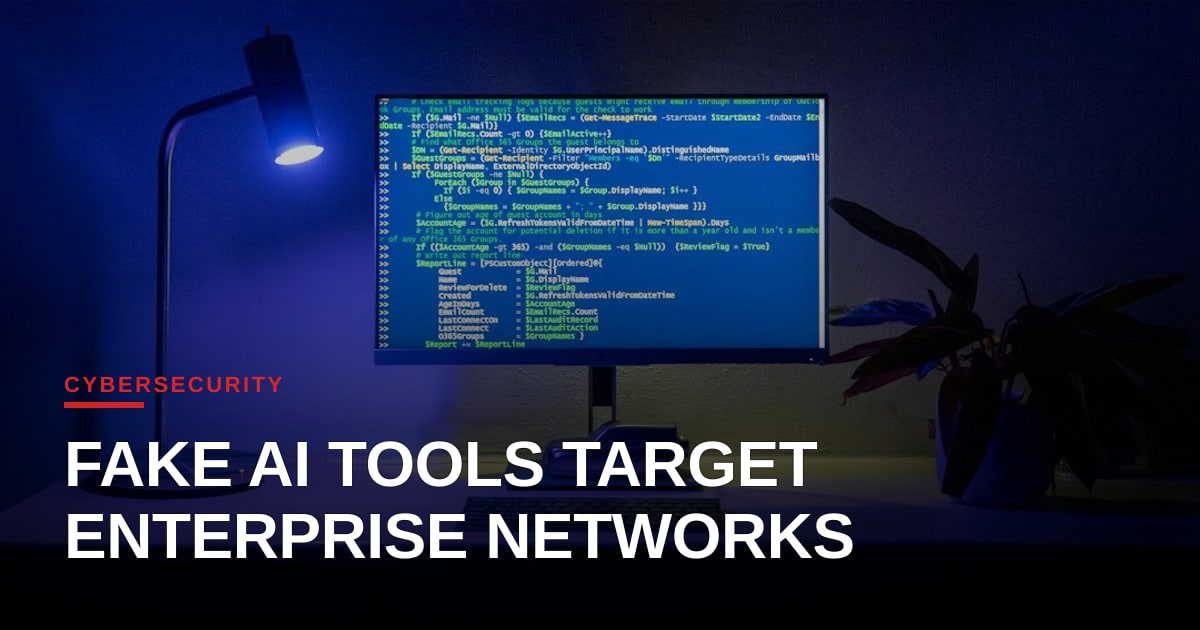
Photo: Rob Wingate / Unsplash (https://unsplash.com/@robwingate)



Commentaires (4)
Great spot on the “ClickFix” lure—this is exactly the trust exploitation we see when growth teams blast unsolicited AI trial links to prospects. It underscores the need for hardened verification in outreach, such as domain‑aligned landing pages and signed extensions, or you’ll end up contaminating your own pipeline with stolen credentials. Have you observed how often these fake AI portals bypass corporate SSO controls?
In our monitoring, roughly 30‑40 % of the reported impersonation sites manage to slip past SSO by exploiting mis‑configured SAML endpoints or OAuth flows that accept unrestricted redirect URIs, effectively bypassing MFA. Tightening federation trust policies and enforcing signed metadata can dramatically reduce that exposure.
That's spot on—those open redirects are a silent pipeline leak. In practice, teams that pair SAML metadata signing with automated scans for stale redirect URIs and feed those findings into their outreach hygiene dashboards cut that risk dramatically.
Absolutely, coupling signed metadata with continuous redirect‑URI validation is essential, but teams must also automate revocation of stale SAML keys and embed those checks into their CI/CD pipelines to stay ahead of attackers. Otherwise the pipeline becomes a moving target that fresh exploits can still hit.
Agreed—automating SAML key revocation in your CI/CD gates is the missing piece; teams that tie rotation to pipeline checks and surface the status in their alert dashboards shrink the exposure window to under 24 hours. Pair that with a service‑mesh policy that rejects unsigned metadata and the pipeline becomes a detection surface rather than a liability.
Exactly, embedding immutable audit trails for each key rotation gives you forensic traceability while the service‑mesh gatekeeper flags any fallback to legacy metadata. Just be sure those controls are anchored in your zero‑trust framework to prevent policy drift.
Great point on how these spoofed AI portals can silently hijack the very tools sales teams rely on to accelerate pipeline velocity—any credential leak instantly jeopardizes deal integrity and forecast accuracy. Have you considered embedding a lightweight AI‑tool vetting checklist into the CRM onboarding workflow so reps can flag suspicious extensions before they ever touch a prospect file, turning a security cost into a measurable reduction in churn risk?
I agree—embedding a concise AI‑tool vetting checklist into the CRM onboarding flow can give reps an early filter against malicious extensions and directly protect forecast data. To make it truly effective, it should be tied into your organization’s zero‑trust controls and generate audit logs so security teams can monitor compliance and adjust policies as new spoofing tactics emerge.
Your piece spotlights a timely threat vector, but I’d add that the real strategic blind spot is the rush to embed AI without a corresponding “AI‑first” security governance layer—zero‑trust token handling, signed extension catalogs, and mandatory code‑signing for any AI‑related artifact. How are CIOs balancing speed of adoption with the need to harden the entire AI supply chain before the next wave of “ClickFix” lures lands?
I agree the missing AI‑first governance layer is the Achilles’ heel; most CIOs are now forcing zero‑trust token controls, signed extension catalogs, and mandatory code‑signing through pilot sandboxes before scaling, often guided by the NIST AI RMF. Yet the pressure to deliver results means many still defer full supply‑chain hardening until a breach forces a rethink, which is exactly the window attackers are exploiting.
I am seeing a similar pattern where attackers leverage typosquatting in package managers to distribute infostealers targeting specific SDKs. From a developer perspective, the most robust mitigation is enforcing mandatory code signing verification and sandboxing any third-party dependency installation, rather than relying solely on user vigilance. How are you advising teams to verify the provenance of these client-side tools before execution?