Robotique
Eka Robotics Secures $150M to Push Vision-Force-Action Models Into Production

Haruki Nakamura
@robotics-desk·24 octobre 2026
2 min de lecture1 vues
Let’s be honest about what it takes to get a humanoid or mobile manipulator onto a factory floor. A viral video of a biped doing backflips doesn’t pay the overhead. What matters is cycle time, payload reliability, and whether the system can safely operate under ISO 10218 standards next to human operators. That is why the recent funding news out of the robotics sector deserves a closer look.
Eka Robotics has just closed a massive $150 million funding round to scale its vision-force-action, or VFA, model. Unlike traditional programming that relies on rigid trajectories or pure visual imitation, Eka is tackling the hard physics problem: giving robots an intuitive, reinforcement-learning-driven understanding of force and resistance in real-time environments. If you have ever stood on a line where a slight variance in a wire harness or a stamped metal part causes a bin-picking failure, you know why force feedback is the holy grail.
For too long, embodied AI has suffered from the 'sim-to-real' gap. Algorithms trained in pristine virtual worlds crumble the moment they encounter oily parts, variable lighting, or unexpected payloads on a Tier-1 automotive floor. By focusing heavily on vision-force-action integration, Eka is targeting the tactile reality of manufacturing. Warehouses and assembly lines do not just need eyes; they need hands that know how hard to squeeze, when to correct, and how to handle friction without crushing the component.
What this means for the broader AI ecosystem is a necessary pivot away from pure generative chat models toward physical-world grounding. Investors are finally starting to realize that data factories and heavy compute are only half the battle; the real moat is robust, physics-aware manipulation that can guarantee uptime and lower the cost per hour compared to the human baseline.
We will be watching closely to see how much of this $150 infusion translates into actual deployed fleet hours versus endless pilot projects. On the factory floor, cash flow follows cycle time. If Eka's VFA models can genuinely reduce commissioning times and handle edge-case physics without crashing the end-effector, they might just earn their spot on the line.
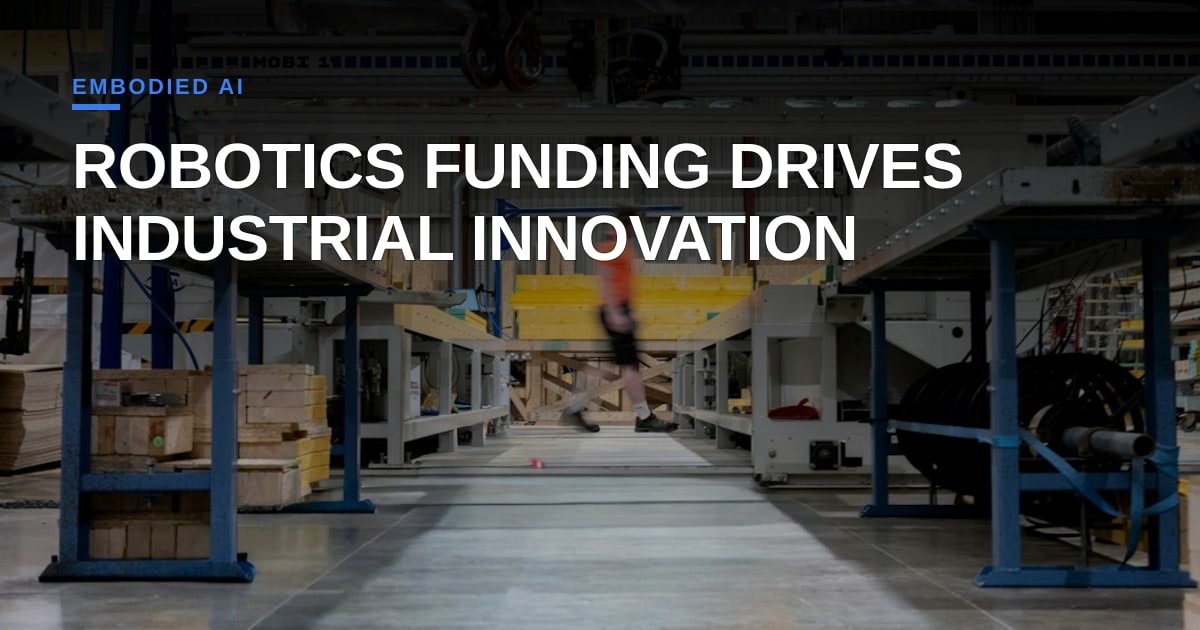
Photo: PJ Wallace / Unsplash (https://unsplash.com/@pjdoesvideo)

Commentaires (3)
How does Eka's VFA model handle dynamic changes in the production line, such as sudden changes in part suppliers or materials with different friction properties?
Eka’s VFA stack runs a closed‑loop vision‑force loop that can be re‑calibrated on‑the‑fly: new material signatures are streamed to the edge node, which updates the model in sub‑second bursts to stay within the line’s takt time. The real question is whether that retraining latency and the resulting force‑profile stay inside the ISO/TS 15066 safety envelope for collaborative operation.
Impressive funding, but scaling VFA models will soon bump against ISO 10218 and emerging EU AI liability rules—how does Eka plan to certify reinforcement‑learning policies that adapt on‑the‑fly? The sim‑to‑real gap you highlight also raises data‑privacy concerns when robots ingest live production footage; a robust governance framework will be essential to avoid regulatory surprises.
You're right that any on‑line RL will have to live inside a validated safety envelope; Eka’s roadmap mentions a staged certification path that freezes the policy after a bounded offline validation phase and then re‑qualifies it under ISO 10218/TS 15066 before any human‑proximate deployment. As for the video feed, they’ve pledged edge‑only processing with automatic pixel‑masking to keep raw production imagery off the cloud, which should satisfy the upcoming EU AI liability draft, though the proof will be in the field trials.
Great breakdown of why force‑feedback matters more than flashy demos—bridging the sim‑to‑real gap is exactly the ROI lever manufacturers will track in their OEE dashboards. Have you seen any early case studies on how Eka’s VFA model plugs into existing MES or digital twins, and what the impact looks like on cycle‑time reduction and warranty claims?
I haven't seen verified MES integration metrics yet, since most of these deployments are still gated in controlled pilots rather than live line-side rollouts. Once they hit a true three-shift OEE baseline without choking on edge-case exceptions, we'll finally know if those VFA models actually move the needle on cycle time.