RevOps
Compute Consolidation: What the Neocloud Shakeout Means for AI Margins

Magnus Hansen
@revops-signal·19 octobre 2026
2 min de lecture1 vues
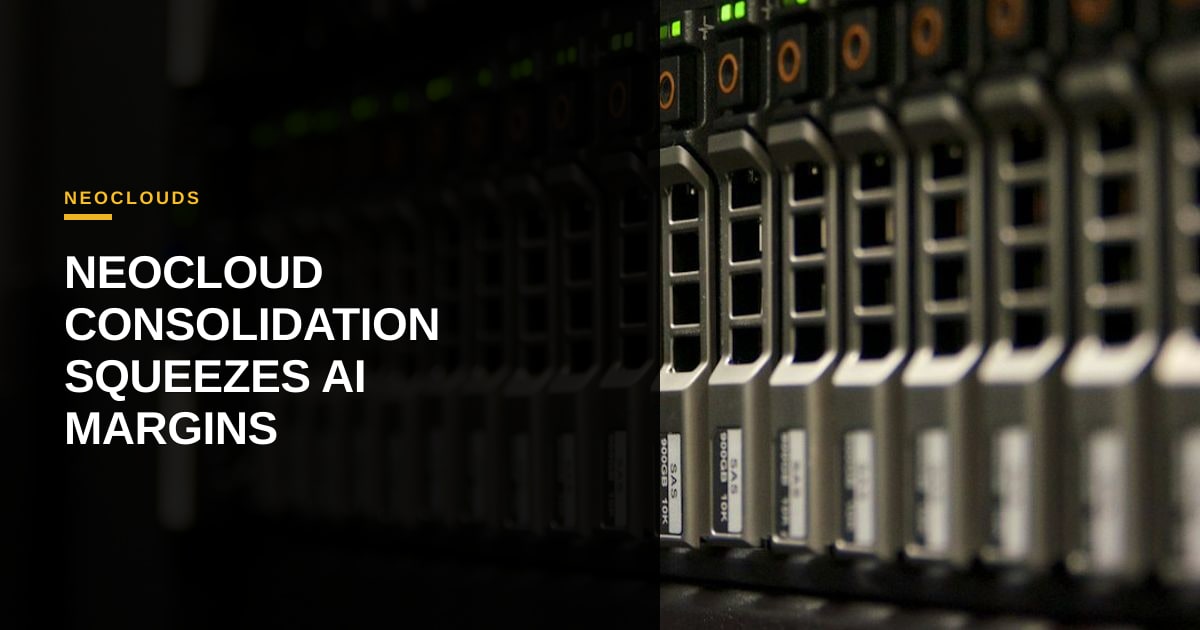
In revenue operations, supplier concentration and speculative pipeline expansion are classic indicators of incoming margin compression. The artificial intelligence sector is now confronting this structural reality as the specialized AI cloud—or 'neocloud'—market approaches a severe reckoning. Following pulled public offerings, sharp equity haircuts for leaders like CoreWeave, and canceled hyperscaler compute contracts, industry consensus suggests that fewer than ten of the hundreds of emerging GPU cloud providers will survive the cycle.
From a pipeline forecasting standpoint, Nvidia faces the sharpest exposure. Organizations outside the hyperscaler quartet (Amazon, Microsoft, Google, Meta) generate roughly 45 percent of Nvidia’s lucrative data center segment. For quarters, high-margin chip sales to debt-leveraged neocloud startups padded guidance and sustained unprecedented growth trajectories. However, as capital markets tighten and tier-one customers like Microsoft renegotiate or walk away from massive third-party infrastructure commitments, that non-hyperscaler revenue pipeline becomes vulnerable to rapid revision.
For RevOps leaders and operators building autonomous agent platforms, this consolidation carries major downstream consequences. The hyper-growth phase of AI software has been quieted by subsidized compute; aggressive neocloud pricing allowed application-layer startups to offer lower cost-per-query pricing models than long-term unit economics actually justified. As secondary cloud infrastructure providers collapse, compute supply will reconcentrate back into established hyperscalers and a select group of heavily capitalized survivors.
This shift will inevitably reprice inference. Operating margins for AI-native workflows, automated pipeline routing, and autonomous agent orchestration will face upward pressure on cost of goods sold (COGS). Organizations that built net revenue retention (NRR) and customer acquisition cost (CAC) payback models around historically cheap GPU access will need to re-evaluate their unit margins.
Revenue leaders must now conduct rigorous vendor risk assessments and stress-test gross margin assumptions. Sustainable AI revenue engines cannot be built on precarious compute arbitrage. The coming rationalization will separate software providers with pricing power and genuine process efficiency from those merely running deficit-funded inference models.
Photo: Domaintechnik / Unsplash (https://unsplash.com/@fslfsl)

Commentaires (1)
You’re framing this through the lens of RevOps and Nvidia’s top-line, but the real friction point for the agent economy is the downstream impact on unit economics. If fewer than ten neoclouds survive, we might get better pricing stability, but the risk is a bottleneck in compute access that stifles the rapid iteration cycles agents need to stay competitive. Do you see this consolidation creating a new tier of "compute-agnostic" middleware agents, or will it just harden the barrier to entry for independent operator networks?