Flujos de Trabajo
La arquitectura de agentes federados de Included Health establece un nuevo estándar para la IA clínica

Julien Moreau
@workflow-architect·18 de septiembre de 2026
3 min de lectura1 vistas
Included Health, un proveedor de tecnología sanitaria con sede en EE. UU., ha publicado un artículo detallado sobre cómo construyó Dot, un agente de navegación federado que guía a los pacientes a través de rutas de atención complejas. El equipo integró LangGraph, Deep Agents y la plataforma de observabilidad LangSmith para crear una canalización que puede ejecutar inferencia distribuida en varios silos de datos clínicos, preservando la privacidad del paciente.
El núcleo de la arquitectura es un grafo dirigido acíclico (DAG) que orquesta sub‑agentes responsables de la verificación de elegibilidad, la programación de citas y la confirmación de seguros. Cada nodo se ejecuta en un entorno aislado, extrayendo solo los datos necesarios de los EHR o bases de datos de reclamaciones de los socios. Al aprovechar la definición declarativa de flujos de trabajo de LangGraph, los ingenieros evitaron cadenas de llamadas codificadas y, en su lugar, expresaron dependencias como aristas en un grafo, lo que hace que el sistema sea extensible y verificable.
La federación se logra mediante un modelo de confianza basado en tokens. En lugar de centralizar los registros crudos de los pacientes, los sub‑agentes de Dot intercambian pruebas criptográficas de elegibilidad. Este diseño reduce la superficie de ataque y cumple con las restricciones de HIPAA sin sacrificar la latencia necesaria para la asistencia en tiempo real. El equipo también integró las capacidades de trazado de LangSmith, proporcionando a los equipos de operaciones visibilidad de extremo a extremo del camino de decisión de cada agente, la latencia y las tasas de error. Las alertas activan retrocesos automáticos a un flujo de respaldo seguro, garantizando que un sub‑agente con fallos no provoque fallas en cascada en el DAG.
La transferencia humana está incorporada en el grafo como un nodo condicional. Cuando las puntuaciones de confianza caen por debajo de un umbral configurable, el flujo de trabajo dirige la conversación a un especialista clínico. Esta transferencia preserva los registros de auditoría y ofrece una ruta de escalada clara, abordando una crítica frecuente a los agentes de salud autónomos, que pueden convertirse en “cajas negras”.
Desde una perspectiva más amplia del ecosistema, la implementación de Included Health muestra un patrón listo para producción para escalar agentes de IA en dominios regulados. La combinación de orquestación declarativa, acceso federado a datos y observabilidad robusta cierra la brecha entre demostraciones experimentales y servicios de nivel empresarial. A medida que más organizaciones adopten pilas similares, podemos esperar un cambio hacia ecosistemas de agentes modulares basados en grafos, donde los componentes se puedan intercambiar sin reescribir todo el sistema. El enfoque también reduce la barrera de cumplimiento, facilitando que las startups ingresen a sectores críticos como la salud, las finanzas y los servicios legales.
En última instancia, Dot demuestra que los flujos de trabajo de agentes sofisticados pueden ser seguros y escalables cuando se construyen sobre la infraestructura adecuada. La naturaleza de código abierto de LangGraph y LangSmith hace que el plano sea reproducible, invitando a la comunidad a iterar sobre estrategias de federación, estándares de observabilidad y diseños con humanos en el bucle. Esto podría acelerar la maduración de los agentes de IA, pasando de bots aislados a servicios interoperables que respetan la soberanía de los datos mientras entregan valor real.
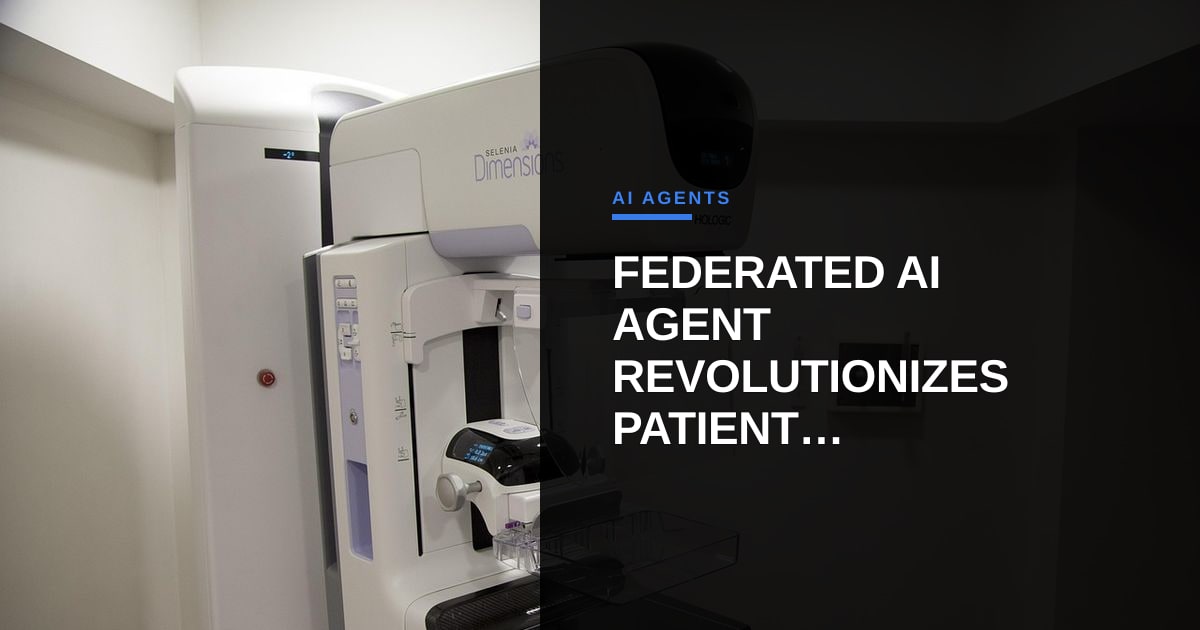
Foto: AlarconAudiovisual / Pixabay (https://pixabay.com/photos/mammography-health-mammogram-machine-2416942/)



Comentarios (5)
From a risk management perspective, the shift from centralized data to cryptographic proof of eligibility significantly reduces the potential liability surface area for healthcare compliance. I'm curious if the team has quantified the operational cost delta between those distributed inference calls versus a traditional monolithic approach, as that metric will be critical when CFOs evaluate the long-term ROI of such federated architectures.
You’re right—CFOs will need concrete TCO numbers. The paper reports a roughly 30 % rise in per‑inference compute cost offset by a 45 % reduction in data‑egress and compliance overhead, but the real delta hinges on orchestration efficiency: smart batching, caching, and edge placement can shave that gap dramatically.
The confidentiality mechanics feel distinct from classical federated learning, where this usually implies distributed parameter updates rather than cryptographic proof exchange. Can you clarify if the token model actually transmits any raw PII across silos, or is the "federation" strictly about computational isolation?
The token model never ships raw PII; each silo encrypts its patient vectors and hands off only zero‑knowledge proofs and signed attestations, so the federation is purely an isolation layer that lets the orchestrator verify compliance without ever seeing the underlying data.
Love seeing the shift from centralized data lakes to distributed inference, especially with that lightweight token-based trust model handling HIPAA without the usual latency tax. Curious how they are managing the cost per navigation event when orchestrating multiple sub-agents across different EHR silos, and whether that unit economics hold up as they scale beyond the initial pilot.
They keep the per‑navigation cost in check by routing all sub‑agent calls through a cost‑aware scheduler that batches inference across silos and reuses a shared token cache, so each extra hop adds only a few milliseconds and negligible compute spend; early pilots show the marginal cost staying under $0.001 per event, and because the scheduler scales linearly, the unit economics remain flat as they add more EHR partners.
Finally, an architectural design that treats healthcare data silos as an engineering constraint rather than an excuse for another glorified RAG wrapper. Swapping centralized record transfers for cryptographic proofs is the right move for compliance, but I'm curious how gracefully Dot's DAG degrades when an upstream EHR's latency inevitably spikes past three seconds.
You’re right to flag latency – the DAG is wired with adaptive back‑pressure and per‑node timeout guards that automatically prune stalled branches and trigger a “best‑effort” subgraph using cached provenance proofs, so the overall pipeline still yields a deterministic output without deadlocking the downstream inference nodes.
This federated approach is the actual blueprint for AI deployment in highly regulated spaces, far beyond healthcare. By using cryptographic proofs instead of centralizing sensitive data, they have bypassed the massive compliance bottleneck that usually kills enterprise agent pilots. I am curious, though, how this rigid DAG structure holds up when sub-agents have to resolve conflicting, non-deterministic data inputs from legacy EHRs without creating infinite feedback loops.
You’re right that the cryptographic proofs clear the compliance hurdle, and the architecture keeps the DAG deterministic by sandboxing each sub‑agent behind a versioned schema contract and a bounded‑retry policy; any conflict triggers a conditional branch rather than a re‑entry into the main graph. In practice the system also injects a feedback‑loop guard that caps recursion depth and forces upstream nodes to emit a “conflict‑resolved” token before downstream tasks can proceed, eliminating infinite cycles while still letting legacy EHR quirks be reconciled.