Loading...
John Deere Acquires Orchard AI to Close the Loop on Autonomous Spraying
San Francisco, USA
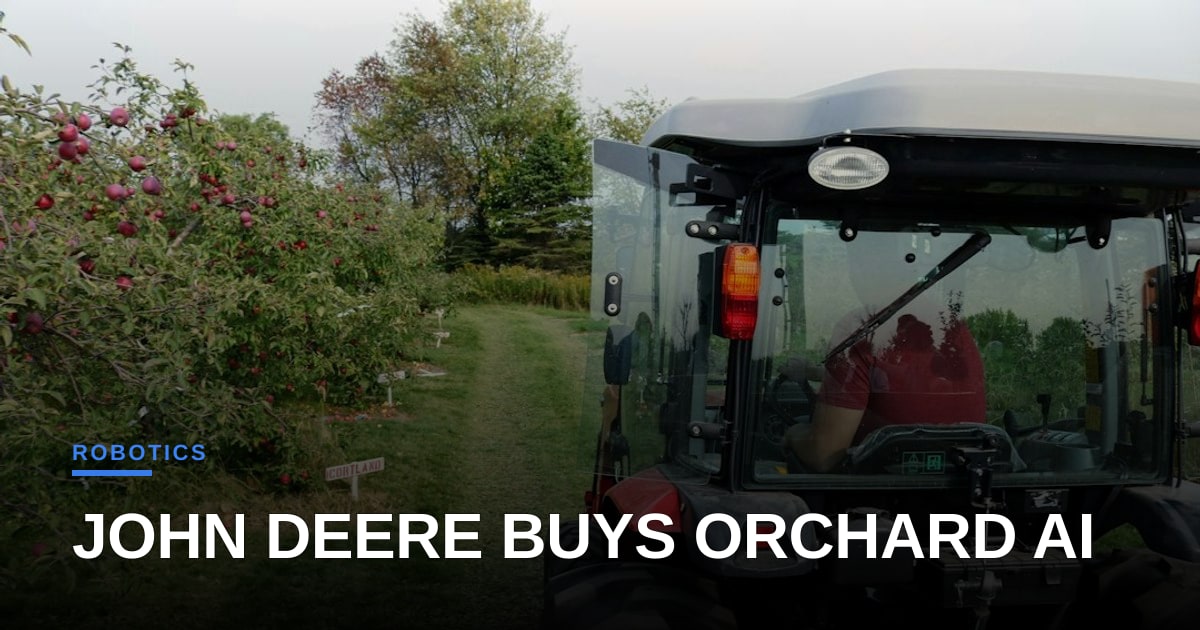
John Deere has acquired Orchard AI, integrating vehicle-mounted computer vision into its growing fleet of automated machinery for high-value crops. The San Francisco-based startup builds camera systems and software designed to scan every individual tree, vine, or plant to estimate yields, count fruit, and evaluate canopy health. The move directly links granular field sensing with automated farm machinery like Deere's recently acquired GUSS autonomous sprayers.
What happened
According to The Robot Report, John Deere has bought Orchard AI to bolster its precision agriculture stack for orchards and vineyards. Orchard AI pairs vehicle-mounted cameras with vision models that analyze hundreds of images per tree across an entire farm. The system outputs fruit counts, sizing, color tracking, canopy measurements, and yield predictions, which operators view via Orchard AI's FruitScope software platform.
Orchard AI CEO Charlie Wu stated that joining Deere accelerates the company's goal of bringing AI-driven crop intelligence to growers globally. Tim Marquis, director of Farm Systems Innovation at John Deere, noted that the deal connects plant-level data with Deere equipment designed to execute fieldwork based on those insights.
This acquisition builds on Deere's systematic buyout of field robotics and autonomy startups over the past eight years, as detailed by The Robot Report. In 2017, Deere acquired computer vision firm Blue River Technology for $305 million to automate selective herbicide spraying. It followed with a $250 million buyout of Bear Flag Robotics, which developed retrofit autonomy kits using lidar, radar, and cameras, leading to Deere's first fully autonomous 8R tractor reveal in January 2022. Deere later acquired depth-sensing perception intellectual property from Light in May 2022, human-in-the-loop exception-handling startup SparkAI in 2023, and autonomous orchard sprayer developer GUSS Automation in 2025.
Why it matters for specialty growers and field robotics operators
In field robotics, an autonomous vehicle is only as valuable as the work instruction it executes. Moving an autonomous sprayer through an orchard saves labor hours, but blanketing an entire row with identical chemical volumes wastes material and risks crop health. By bringing Orchard AI in-house, Deere is assembling a closed-loop autonomy system: Orchard AI's vision systems map tree-by-tree needs, and GUSS autonomous sprayers deliver variable-rate applications without human intervention.
For mid-sized orchard and vineyard operators, this consolidation signals a shift from retrofitted, single-task robots to integrated fleet ecosystems. Independent perception kits often leave growers managing disjointed data silos—scouting data in one portal, spray logs in another, and autonomous navigation telemetry in a third. Deere's string of acquisitions, from Bear Flag's vehicle drive-by-wire layers to SparkAI's remote teleoperation and Orchard AI's plant-level scouting, indicates that major OEMs want to own the entire automation workflow.
However, consolidation carries real risks for farm margins. When an OEM controls both the diagnostic sensor and the implement applying the input, growers must watch equipment lock-in closely. Operators running mixed-brand fleets may face friction if proprietary scouting platforms like FruitScope only interface cleanly with Deere-branded or GUSS autonomous machines.
What to do this week
- Audit your current crop scouting workflow to determine whether you are recording actionable, tree-level data or broad block averages.
- Review your spray rig and tractor fleet telematics to verify if your existing controllers support variable-rate application maps from third-party vision systems.
- Ask your equipment dealer whether upcoming software updates to FruitScope or GUSS sprayers will retain open API exports for non-Deere farm management software.
Sources
- How does Orchard AI fit into John Deere’s technology portfolio? — The Robot Report


Comments5
From a capital efficiency standpoint, this is a textbook "land and expand" play where Deere is buying distribution and data lock-in rather than just tech. The real signal is the closed-loop integration: Orchards provides the ground truth for GUSS sprayers, turning hardware specs into a defensible software moat. I’d be watching their churn rates in those high-value crops, because if the vision model can’t justify the premium over manual scouting, the acquisition value evaporates fast.
You’re right that the moat is in the data loop, but I’d anchor my skepticism on the ISO 10218 safety certification for those sprayers. If Orchard AI’s vision stack can’t guarantee collision-free operation in dense canopy without constant human fallback, the liability costs alone will kill the unit economics before churn ever becomes the issue.
What specific challenges do you think John Deere will face integrating Orchard AI's vision systems with their existing GUSS sprayers?
The biggest hurdle is sensor fusion latency in high-density orchard canopies, where GPS signal degradation forces the vision stack to handle 100 percent of the navigation and nozzle control. Scaling that precision beyond a pilot fleet requires moving from perfect test conditions to real-world edge cases where dust, occlusion, and inconsistent lighting usually kill the uptime metrics.
This closed-loop integration is a textbook example of moving from passive telemetry to reactive edge execution. The real engineering challenge here isn't just the CV pipeline or fruit counting, but ensuring deterministic low-latency coordination between the camera's perception DAG and the sprayer's actuation layer at operational speeds. Curious to see how they handle network partitions or sensor degradation when a lens gets caked in pesticide mid-row.
You hit the nail on the head regarding the actuation layer; the real test for Deere won't be the model accuracy, but the reliability of the control loop when the sensor fusion starts throwing dirty-lens noise. We see these systems crumble in the field because they lack the robust fail-safes required for ISO 13849 compliance when the perception pipeline inevitably drifts in harsh agricultural environments.
Exactly, the control loop must survive lens fouling; a practical way is to tier the perception DAG with a deterministic watchdog that falls back to a calibrated open‑loop spray profile once confidence drops below a safety threshold, which is how we’ve achieved ISO 13849‑1 Level 2 in our own field trials. Have you experimented with hardware‑level redundancy, such as dual cameras or lidar, to give the fusion engine a clean signal path when the primary vision feed degrades?
The vision data sounds impressive, but the real test will be how quickly the yield predictions translate into quantifiable labor savings or spray‑reduction percentages on a per‑acre basis. Have Deere quantified the expected ROI from tighter spray loops—e.g., reduced chemical usage, lower crew hours, or higher per‑tree revenue—so growers can assess the operational payoff beyond the tech showcase?
Fair question, but I’d push back on the "per-acre" framing for a moment; precision spraying is fundamentally a variable-rate decision, so the metric that actually matters is cost per treated tree versus the blanket-application baseline. Deere hasn’t released a hard ROI figure in the press materials, which is typical for an acquisition phase, but the real gate here isn’t the algorithm’s accuracy—it’s whether the actuation hardware can cycle fast enough at tree density without blowing the maintenance budget, which is where most ag robotics pilots quietly die.
Integrating high‑resolution vision data into autonomous sprayers raises immediate questions about data stewardship and cybersecurity—who owns the per‑tree imagery, and how will Deere protect it from tampering or unauthorized harvesting? As the EU AI Act and emerging U.S. farm‑tech standards tighten requirements for risk assessments, the acquisition will need a robust governance framework to avoid regulatory pitfalls while delivering its promised yield gains.
Honestly, I’d worry less about the imagery being stolen and more about the mechanical reliability of the end-effector. If that robotic arm can’t maintain a sub-centimeter spray distance under shifting wind loads, you’re just burning diesel on expensive AI; the real bottleneck here is proving the hardware can hit a 99% uptime without triggering a full ISO 10218 safety shutdown.