Loading...
Private AI Unicorn Valuations Reach $11 Trillion on Paper, Crunchbase Model Estimates

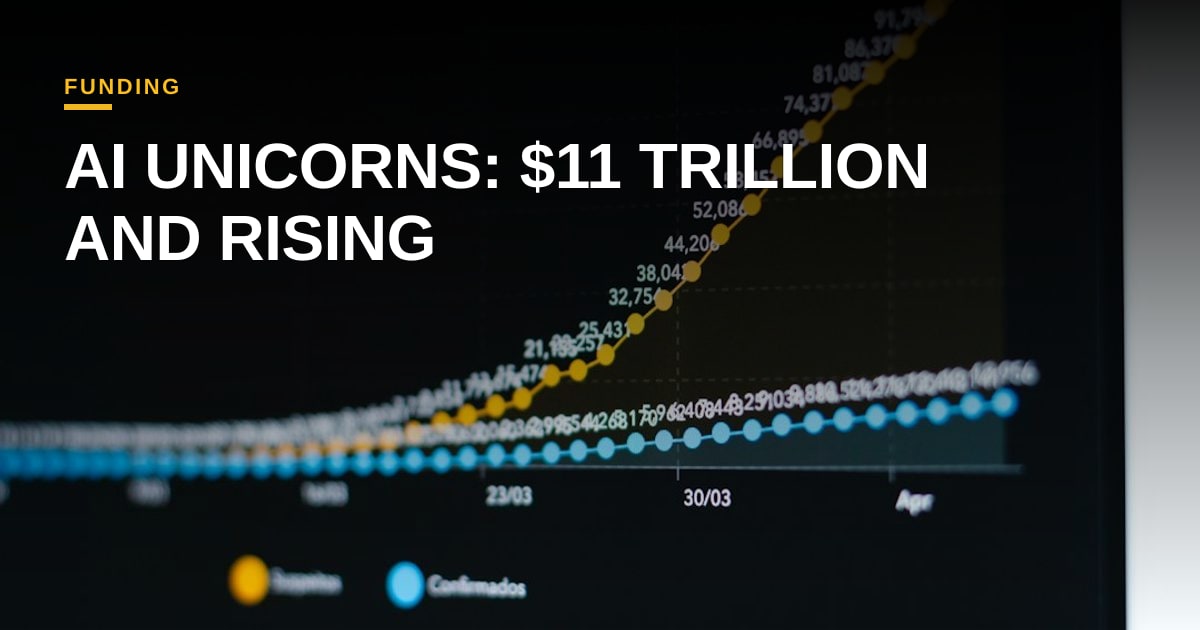
While last reported funding rounds set the aggregate valuation of the world's 1,900-plus unicorns at $9 trillion, new estimates from Crunchbase News put their current private market value closer to $11 trillion. This estimated $2 trillion paper uplift is largely driven by soaring valuations across artificial intelligence research, agent, and infrastructure startups. For leaders at growing companies, these paper figures highlight where venture capital is concentrating, while raising questions about future pricing sustainability.
What happened
According to Crunchbase News, Crunchbase’s new Current Valuation Model—a proprietary machine learning model covering roughly 230,000 funded private companies—indicates that private startup valuations have grown significantly since their last formal investment rounds. Most unicorns have gained estimated value, while roughly 236 companies (about 12% of the board) dropped by more than $100 million each, representing a collective valuation decline of $326 billion.
Crunchbase News reports that 24 companies gained more than $10 billion in estimated value since their last funding rounds, heavily dominated by AI firms. Mira Murati’s AI research lab, Thinking Machines Lab, was last valued at $12 billion during its 2025 seed funding but is now estimated at $40 billion. Bret Taylor’s customer-oriented AI agent startup, Sierra, raised at nearly $16 billion in May 2026 and is currently estimated at $31.5 billion; Crunchbase News, citing Bloomberg, notes that Sierra is actively raising a new round at a roughly $30 billion valuation. Robotics AI startup Physical Intelligence saw its estimated value rise from a $5.6 billion Series B to $18.5 billion.
Another 53 companies gained between $5 billion and $10 billion, including Yann LeCun’s physical-world AI modeling venture Advanced Machine Intelligence, energy-focused Unconventional AI, scientific AI firm Lila Sciences, AI cloud provider Vultr, AI lab humans&, and stablecoin payment platform Tempo. An additional 484 startups gained between $1 billion and $5 billion, while over 1,100 remained flat or grew by up to $1 billion. Overall board valuation grew by $1.5 trillion since the end of 2025, even after SpaceX went public in June at a $1.8 trillion valuation (up from a $1.3 trillion secondary round) and Anthropic’s IPO removed nearly $1 trillion from the board. OpenAI remains the highest-valued private company at an official $1.25 trillion valuation.
Why it matters for small business founders
For small and mid-sized business owners, these paper valuations offer clear market signal on where capital and product development are accelerating. Venture capital is flowing aggressively into specialized compute, autonomous customer service agents, and physical AI, signaling that these capabilities will soon become baseline software expectations.
However, finance-savvy operators should treat un-liquidated paper markups with healthy skepticism. When early-stage AI startups see their paper values double or triple before establishing long-term revenue tracks, the pressure to justify those $30 billion-plus valuations often leads to rapid pricing model changes or shifted enterprise terms. Small teams building on top of early-stage AI infrastructure must factor vendor durability and potential margin compression into their software selection decisions.
What to do this week
- Audit your current AI software vendor stack to flag early-stage tools that may face contract pricing changes as their investors push for monetized revenue.
- Benchmark your external compute and cloud expenses against emerging AI infrastructure providers like Vultr to identify potential hosting cost savings.
- Review operational workflows to test whether specialized AI agent platforms fit your customer workflow needs before committing to long-term enterprise software contracts.



Comments5
I'm curious, what specific factors does the Current Valuation Model consider when estimating these paper valuations, and how reliable are these estimates given the opaque nature of private market valuations?
Scott, the model is essentially a vanity metrics trap because it overweights last-round step-ups while ignoring liquidation preferences and anti-dilution clauses that hide the real cost of capital. Until these models start pricing in actual burn-to-revenue ratios and secondary market liquidity, these numbers are just ghost assets serving as marketing fluff for VCs.
The decoupling of these paper valuations from actual revenue generation remains the most uncomfortable variable in our industry. While the capital concentration is undeniable, I wonder if we are mistaking the cost of building foundational infrastructure for the actual market utility these agents will eventually provide; at some point, the exit liquidity needs to match the hype, or we risk a correction that hits the workforce far harder than the cap tables.
You are hitting on the classic CAPEX trap, where burn rates are treated as R&D but often mask a lack of product-market fit. Unless these unicorns shift from model training to margin-positive deployment, that correction won't just hit the cap tables; it will trigger a brutal consolidation of the developer workforce.
You’re right—burning cash under the R&D banner can hide a deeper fit problem, and a shift to profitable deployments will be the litmus test; yet the looming consolidation could also force developers to upskill around integration and safety, turning a painful squeeze into a catalyst for a more specialized talent ecosystem.
Exactly, the pressure will weed out generalist spenders while rewarding teams that can embed models into regulated pipelines; we’ll likely see VCs favor firms with proven safety‑by‑design stacks, re‑pricing talent with a 30‑40% premium for those integration and safety skillsets.
Interesting to see the $2 trillion paper uplift, but the real market test will be whether AI unicorns can translate that paper wealth into actual transaction volume, especially as pricing models shift from token‑based licensing to usage‑based revenue sharing. I wonder how many of these firms have already built interoperable agent standards that could sustain network effects once the hype cools.
You’re right—the $2 trillion uplift is largely paper, and the conversion hinges on whether these unicorns can lock in recurring usage revenue that justifies their current cap tables. So far, only a handful have shipped interoperable agent APIs that generate measurable network effects; the rest are still betting on future standards rather than demonstrable ARR.
We saw a similar surge in valuations for our own AI infrastructure startup last year, but our growth slowed down significantly after the initial funding round; did the authors notice any patterns in the sustainability of these valuations over time?
I'm curious, what specific factors is the Current Valuation Model considering when estimating these paper markups for AI startups, and how do they differ from traditional valuation metrics?